Showing posts with label Religiosity. Show all posts

Sunday, January 18, 2026

Prayer: Not a sign of Lunacy


We humans are truly difficult to understand. At times.

In one vein, everybody tells us to pray always, regardless of the result or whether or not our pleas are answered.  We should never relent with prayers.

But in another vein, we are told that doing the same things over and over again expecting different results is a sign of lunacy.

Is there any logical explanation to this apparent contradiction? There certainly is.  And both sayings are justifiably true. You see, the act of prayer is more than just the motions associated with it. It includes all the resolutions to action that accompany it as a natural consequence.

Going back to the Ignatian definition of prayer:  Pray like everything depended on God, but act on it like everything depended on you.

Therefore, inextricably intertwined with it are the host of actions we resolve to do so our prayers can come to fruition. And thus, if our prayers are not initially fulfilled or answered, we pray again and this time with another host of resolutions to guarantee our pleas are answered.

Therefore, our prayers are not simply repetitions, but each time, unique and different in its own ways.

Many of us do forget how we ought to pray efficaciously, and thus, court the mockery of others who dismiss our praying as simply either a fool's errand, or the protestations of a crazy person.

This because we limit our interpretation of praying to the words we express in our supplications as we lay prostate either in solitude or in church. We mouth the same formulaic verses, and repeat them countless times like in the rosary and the litanies, and after that we wait for any response. No doubt others feel justified in their criticism.

So remember prayer does not end with pious words said in solemn moments. As we learn in the Morning Prayer taught us in school. When we pray we also offer not only prayers, but all "works, joys, and suffering" we go through each day.

Thus each time, our prayer becomes one unique, fresh, and distinct plea to our Creator for his assistance and grace..


Wednesday, September 03, 2025

2 B 8T4

2 B 8T4


In the indolent but idealistic days of careless youth.

Blissfully toyed with the idea of picking a number.

A singular number to characterize the life I live.


Choosing from the finite menu of 10 picked 8.

Which when written on its side spelled infinity.

Symbolizing never-ending existence in time.


And in this newest milestone, we find alignment.

First comes the 8 followed by the second number.

With 4 added to itself gives us the same 8.


The immortality of our soul guarantees infinity.

Add our being the image and likeness of Him.

And we have a desirable bonus to reckon with.


 Beyond the confines of our temporal existence

We aim higher in keeping with sacred covenant.

 To imitate His Son uniquely both God and Man.


We establish necessary premises we can unravel.

Keeping in mind the innate duality of our existence.

And the eternal bond between Creator and Creature.


Our Immortality as simply faint shadow of Eternity.

This we accept 'cause humanity exists in temporal time.

But then our immortal soul transcends human construct.


Our Creator exists beyond the human concept of time.

His entire creation exists in His Mind for eternity.

Included also would thus be the very soul we have.


We can then proceed on ways to imitate our Creator.

Without constraint He so loved that creation came to be.

Though all creation is eternally present in God's mind.


The eternal selflessness of the divine Triune God.

Incarnated in the example of Christ's earthly life.

Is necessarily the mystical model that we follow.


Friday, April 18, 2025

Uncharitable Talk

 No doubt modern man is not now only predisposed to making rash judgment against his neighbor, but this he does with relative ease and speed.

For this we need only take a peek at social media for confirmation.

Premise. This much we know.

We tend to believe everything we hear of our neighbor.  And then we make judgment, typically with prejudice, regardless how little we know of our targets.

In reality to judge others with prejudice is no easy task.  Only wise men or God could do that justly.

This difficulty is heightened by many factors we are saddled with. Our temperament.   Tastes.  Moods. Ambitions, and yes, even our own self-righteousness.

Thus best to leave judgments to others more capable and more invested.  

One may even know better than the one being criticized.  

But remember one can never discern the hidden motives of the doer.

The feeling of superiority when one harshly criticizes another is one very strong drive. And this feeling gets heightened even more when one willfully exaggerates the faults of others.

To Think About.

That our passion could work either for good or for something else.

The passion we exhibit for the people we love and hold dear is good. 

Limited in superlative expression only by our innate reservations.

But the passion we show for the people we abhor or dislike is something else.

Circumspection is the abiding rule, cognizant of that phrase in the Our Father that pleads for God's compassion, 

" forgive us our trespasses, as we forgive those who trespass against us..."

He who loves much, cannot be said to also hate much. 

Wednesday, April 09, 2025

Lenten Week: How Things Have Changed.

 Lenten Week: How Things Have Changed.


Not too long ago drilled into our minds was this pious thought.

Holy Week of Lent was a season for fasting and sacrifice. 


An apt time for reverential solitude amidst the din of daily living.


Time to bear the burden of possible tribulations and vicissitudes 

we could all possibly  endure and should.


These we cramped in those few days of the Lenten season, 

in imitation of the examples set by Christ.


But now when Semana Santa rolls along, 

our harried mind wanders elsewhere.


It starts dreaming of possible hideaways and getaways 

we can hie to and sequester ourselves and families.


All  to escape the hustle and bustle of city life, 

the torrid tropic heat and deafening chaos of urban living.


In other words, with sacrifices bearing down on all, 

we seek to enjoy the few days in ease and comfort.


Yet He did counsel, take up my cross and follow me!  

For only this path leads to eternal life.


We have to empty our vessels with temporal pursuits 

and bow in humble prayer, so we can let Christ in.

Sunday, August 18, 2024

Caution on Public Criticism


While clearly human actions are visible to us, 

And thus subject to our discriminating eyes,

Remember it is God alone that can discern

Hidden intentions and desires of the actor,

Unless unequivocally declared in public.


Good faith on the motives is to be assumed

To be fair and equitable in our judgments.

To rashly ascribe unkind and shallow motives 

Would no doubt clearly be unfair and unjust.

Thus best to exercise circumspection in such.


In another vein, the better part of discretion

Dutifully dictates to those hurt or concerned

To stay quiet about the misunderstandings

Unless keeping in quiet solitude it leads to

Much graver scandal or unnecessary offense.


Friday, August 02, 2024

Our Apostolate Amid The Frailty of Man

 My daily devotionals brought me to the Gospel of St. John, Chapter14, Verse17:

"If thou wilt know the truth, believe in Me." (Christ said.)

Deep down, we all seek peace and truth.  But how do we know where to find peace and seek the truth?  Christ always demands, to get those things from Him.  Not from men, but Him alone, for He is Truth.

Yes, because men can be mistaken or misinformed, or worse have ill-intent or inclined to spread untruth.

And this includes all men, including those held as responsible and truthful, or held reverently by people because of their position or office.

Men are still men!  And thus, still flawed.

Thus, even with the Papacy, we say the Pope is infallible only when he teaches matters of faith and morals, and ex cathedra;  but he is not impeccable, and thus could be wrong in other matters.  

Maybe like putting trust, confidence, or support in people who are purportedly upright and righteous.  In matters like those, his judgment is just as good as any, any person who has studied certain matters and has acquired expertise in such matters.  And admittedly, our reality has proved this to be so and true.

Thus, it is incumbent upon each one of us to search for truth in all places, even in unlikely places, since during these times, truth has become harder to discover and discern.

We cannot anymore be satisfied with getting our dose of truth from our familiar and comfortable places, but to stretch our search beyond that.  And to get tired and dirty searching for it.

And as familiarly intoned, get out of your comfort zones!

 But we of course know that truth is one and indivisible. There are no sides to truth, but there are other sides other than truth.

  As we can see, all this contributes to the confusion, dread, and fears that we witness in the world today. Adding the many dreadful manifestations that we somehow find commonality with everybody else in the world today.

In the early days of our Church, the devout exercises of our Faith to pursue our personal sanctification were considered more than sufficient and we then expected God to do the rest. Thus, in the Church there was a proliferation of monasteries, religious orders, and other institutions promoting monastic life. All geared at very ascetic practices to purify the soul.

But in imitation of Christ, we are also tasked with apostolic duties, to preach the gospels and spread the truth to all. More than just a passive exercise of our Faith, we need to actively pursue this apostolate.

The search for truth is simply a leg of our journey. Having acquired it, there is the need to spread it to the rest of the world. We cannot stand idly by when we see untruth spread like wildfire in the world.

If we are privileged to have learned it, it behooves then for us to pass it around.


Wednesday, April 17, 2024

A FRESH MORNING REFLECTION


Nobody, not even God, begrudges a reasonable desire to  freshen our lagging spirit with a change in scenery.   We are simply cautioned against their too free use for it is easy for them to lead one astray


What is needed more for our own good is really a renewal of good intentions and noble motives for serving higher causes.


What is the lasting good for continually seeking new sights?  Doesn’t that pursuit simply distract us from our nobler purposes?


Desire only enough to improve the quality of our lasting good works and our lives.

Worthy thoughts to have as we wake up each morning of the rest of our lives.


This reflection is about something more direct and straight forward.


The temporal nature of man is a big burden he carries all his life, seeping into the very marrows of his existence.


Thus when he begins to address his impending mortality, he initiates the process of accepting and preparing for it. One then finds in most instances that man continues to cater to this fleeting nature with the plans and resolutions he makes.


Thus he is wont to declare, that because he is close to the end of the road, he needs to take life easy, enjoy new sights and experiences, take leisurely trips, bond more with friends and relations, etc. A common thread in all this is that they all partake of the temporal nature of man.


Remember what the Scriptural admonition for death is? Remember the incident about the man who wanted salvation and so asked Christ what he needed to do with his life knowing it would be taken away from him at an undetermined time?  The answer was curt and succinct. Live your life like you would live the last day of your life.


Implying that the inevitability and urgency require that one focuses on spiritual matters that lead to eternal salvation.


Our late father was one person who was gifted with unique insights into the higher purposes of man. Thus, years prior to his passing he had tried as much as he could to shed himself of the trappings and frailties of this life. Devoting instead his efforts to things that transcended this temporal existence.


But he was also a frustrated man. Having wished and worked so much for more of life, he felt that fortune and ease had escaped him.


The lesson left behind for us to learn is the delicate balance we need to put between spiritual matters and the  alluring things that this life dangles before and offers us. As man, we need to steadily straddle between the two. Except that after this life, only the other remains.


This will be a constant struggle throughout our entire lives.


Thursday, May 18, 2023

In The Threshold of Life, Where Do You Stand?

 As I age even more I find the chasm between the spiritual life (or at least the perception of it) and that of the realities of our living getting wider and wider, rather than closer as the end of our temporal lives comes closer.

As Christians, our avowals to the strict precepts of our Leader, Jesus Christ, get more and more intense, yet we find the daily living of our lives instead veering away more and more from those “hard sayings”.

In no mean terms, Christ has repeatedly intoned that to be like him we must deny ourselves, follow him, and take up our daily crosses.  That life is one battle after another, from one cross to another which at times weigh heavier, till our last dying breath.  That there is no respite for us in these temporal settings.

 The only consolation afforded us mortals has been His words that doing all these, He will send us grace, as a “foretaste” of the eternal kingdom He promised us afterwards.  To illustrate this, consider being under extreme thirst from denial of water for many days, and we get a drop of water in our tongues, just enough to experience the thought of relief that water can bring.  That is to me what foretaste is.

And yet how far have we strayed from these stringent strictures? We still even in our mellow ages, crave for temporal pleasures brought on by our daily pursuits.  The pleasurable trips that we take or planned to take.

The fine rich food we pine for and/or savor.  The idle tasks and camaraderie we thirst for among our friends and relations, and loved ones.

In other words, our pursuits still are essentially those that provide us with the fleeting pleasures of earth, rather than the lasting treasures that are supposed to be laid for eternity.

 And which can come only with our daily taking of our crosses.


Sunday, September 04, 2022

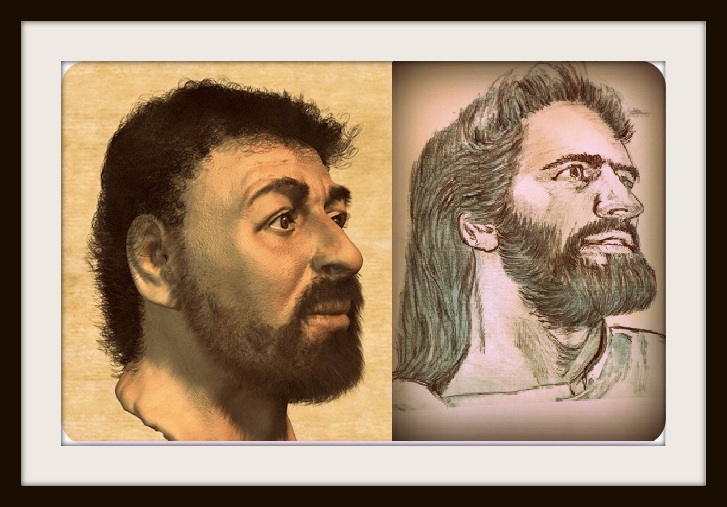
A Perspective: How The Person of Jesus Christ Actually Looked.


To commence to conjure images of the person of Christ after he had ascended,  we first allowed our own individual fertile imagination to roam free, to  festoon and emblazon the resulting images every which way until they became accepted.  This we have done over the centuries, creating differing images to the point of confusion, and even to the point of contention among those who would not accept any other but their own.  Jesus of a hundred faces!  That is what the world of Christianity has created.

This is when stodgy science crept in an attempt to settle the score and to extricate the bones of contention.  So using scientific methods tested and honed through years of studies, it has come out with its own most likely image of Christ, taking into account written data and fossilized figures derived from the same milieu as Christ.

The resultant scientific image of Christ makes Him look just like any Tom, Dick, and Harry, of his own milieu.  Looking very ordinary, insignificant, and maybe mediocre in facial features.  Somebody one can lose easily in any crowd.

Can we accept this as our reverential representation of the Son of the Almighty God, whose very name the ancient Jews could not even assign and/or name, or worse, write down  for fear of displeasing and desecrating Him?

It is ironic but for most significant personages of the ancient world, man has been able to collate enough data, fossil, or representations, to enable him to create passably accurate images of them.  Persons like Alexander the Great, Julius Caesar, even further down the historical holes, like the Neanderthals or the Cro-Magnons. etc.

But for Jesus Christ who lived only over 2000 years ago, we have not been able to till now. One wonders what is behind this unsaid inhibition or reluctance to define the one "official" image of Christ.

Personally, I take ownership of this novel perspective that I will lay out below, just strictly my own.

Before proceeding I consider this caveat.

Over the years, we have read, though mostly heard, that in his sojourn on earth Christ was seen as visiting other faraway places like those in Asia.  Scanty though the accounts may be still many stand by their own truths about such events.  Though Christ was said to have lived amongst such foreign people one has yet to hear about any physical description of Christ coming from those sources.  Somehow, these people must have sensed Christ as nobody any different from them, allowing him to sit amongst them and expound his doctrines.

Many would counter that such incidents are physically improbable given all the circumstances.  But the staid practice  of Parapsychology, a field of study now  generally accepted by pertinent authorities,  has given us some insights.  It has defined and proved to us the unique concept of bilocation or multilocation, which is power an individual has to be present in more than one location at the same time.  In a real way suspending the constraints of time and physics as we humans have learned to believe.

Any Being possessing or predisposed of having such powers must definitely also have other more subtle powers beyond the purview of natural phenomenon.

Thus, Christ in his earthly life when he appeared not only to crowds but to each individual person must have projected himself in ways that the viewer would find as the incarnate manifestation of someone originating from such mystical sphere.  Christ after all was not only more than human but he was perceived as the Redeemer of the entire human race that had been seeking deliverance from its earthly vicissitudes.  Thus to those who beheld him, he/she saw the human perfection of the Being as materialized in each and every unique individual lens that we possess.  Christ as seen not only in the differing grades of vision we each individually are gifted with, but including and not even limited to the prism that we individually perceive our Redeemer to be.

The anonymity of Jesus to his companions who had known him prior, on the road to Emmaus after the resurrection, in a way prods us to think that Jesus dictated how people would view His Person when they saw him. Or to not recognize him at all which the companions on the road to Emmaus did declare.

Thus, a black person sees Christ as the manifestation of perfection in his blackness.  A Chinese or Japanese for their parts would be to manifest Christ in their unique visions of perfection.  Same with the Middle Eastern.  And we could truly say and declare that those are  the correct images of Christ, as the latter allowed himself to be seen by them.

To the white person then, Christ is how he is typically depicted in books, magazines, calendars, etc., which we now currently witness around us.  And that would be accurate, though as an Asian person with an Asian set of perspectives my representation of Christ is obviously different. 

In the final analysis we can only prognosticate about these things, because Christ still is the Final Arbiter.  And as the limited representation of paper, we cannot fully understand the existence of the pencil.


Tuesday, August 16, 2022

The Crucifix


No iconic pendant for a necklace is as universal and popular as the crucifix, which symbol definitely transcends beyond religious beliefs or revered dogmas of wearers.  We know that because many non-Christians are seen to wear them on their necks or persons as well.

For devout Christians they know and swear to the crucifix as righteous symbol of their Master's supreme act of altruism, unjustly executed in the then prevalent punishment edict of crucifixion under the Roman Empire. A punishment reserved for the most vile of criminals though limited to males, who were brutally nailed to the cross to die a slow excruciating death.

We witness the ubiquitous presence  of the crucifix in most places and as worn in persons, from the most profoundly appropriate to the utterly sacrilegious ones.  From pious members of the clergy of most Christian denominations and their equally religious devotees, to the least holy like members of nefarious organizations, or those considered engaged in unethical activities like adult stars.  What about crooked politicians? Regardless, many display them with obvious pride and aplomb.

We could actually hazard the guess that a prevalent reason for the crucifix' s popularity stems from the cluelessness,  or ignorance, or even utter disregard on the part of the wearers in their understanding the symbolic significance of the crucifix.  Many wear them simply as accepted accessory, rather than for their mystical ramifications as religious symbol. 

Nowadays such  pious regard could be farthest from the consciousness of the wearer. Beyond the fact that it is usually made of precious metal, some embedded with precious stones.  In this rare instance, the extrinsic value is the metal it is made of, with the intrinsic value being its mystical representation, plus the inferred promise of personal salvation from a man hanging on a man-made cross.

History gives us a good peek at this atrocious but well applied savage practice for torts committed by men.  And one doubts that what delineates the civil torts from the criminal deeds during those times was quite cloudy as to assume the facility of classifying one from the other, as dictated by exigencies or expediencies of the times.  In other words, regardless what one's crime was or how one pleaded, the kind of punishment meted out depended largely on the magistrate imposing it.

We  learn that it was the glory-imbued Persians who first used crucifixion as punishment for criminals.  And 300 years later the Romans thought it proper to enshrine it  in their unholy empire as proper punishment for grave crimes, perfecting the process for maximum pain and duration.  To mark the trending ascent to the peak of inhumanity which over the ages man has shown to possess as one distinctive trait in his march to history.

The Romans did so much perfecting it, that modern medicine has detailed in writing  in scholarly but antiseptic fashion  all the racking effects of the process on the human body.  To include  those little tweaks the executioners applied for maximum duration of suffering.  Like when the crucified is about to expire due to suffocation, the guards would insert a small stool under the nailed feet so he could painfully raise his agonized body to allow for some breathing.

The medical prognosis go into painful details about which parts of the anatomy were affected by the process.  The joints on shoulders and elbows became disjointed or dislocated as the dead weight of the body mercilessly imposed.  Muscles were stretched but starved with oxygen  because of the ensuing difficulties in breathing from the lungs.  The ribcage did its best to maintain normal functions but was not able to.  The various chemical and fluid reactions as pain and suffering continued to harass the tiring body.  And many more.

The short medical prognosis of the process of crucifixion and the subsequent death on all the affected parts of the human body is so gross and abominable, it is difficult to read to the end of the short treatise.  More unconscionable is the highlighted part on pain and suffering inflicted on the human body as it struggles to stay alive.  So savage and brutal we are told that a learned sage from that era had written that at times the tongues of those fo crucified were cut so as to prevent them from making those weird and indescribable shouts produced almost unconsciously  Shouts that onlookers found so unbearable and objectionable.  His name is known to many, it is Cicero.

Ironic to note that the adjective,  excruciating, is derived from the otherworldly cries emanating from one in harrowing pain during crucifixion.

At the very least, crucifix wearers ought to be educated about this, if only to generate sorrow and remorse for what the world is leading humanity into. And more importantly, as resolve to right humanity's path away from its collective disregard for the rest.

BTW as disclaimer, as I kid I did have a small crucifix pendant with gold chain that our mother had us wear.  Over time, it started to be well-worn until finally the chain broke.  The pendant was kept somewhere and passed on to our kids  

Unlike these days when gold pieces are made in 14k, during that time most came in 18k, and thus may account for quicker wearing away of the softer metal.  Now, I wear a gold pendant with Chinese characters and has weathered through many years of usage.


Friday, April 08, 2022

Musings On The Go


When In Doubt


During bouts of sleeplessness or idle times, one scans through social media groups to pass the time.

And invariably one inherits  the feelings of helplessness and depression.

For what we read are mostly a litany of the things that are observed as being wrong, both in our city and in the whole country. 

Do we need to be constantly and incessantly reminded?

Do we really need to know all the wrinkles we can observe in and around our surroundings?

Isn’t it sufficient especially after all these times to keep those in mind and accept them as there. 

But then start unobtrusively doing whatever little things we may be able to do  both individually and collectively.

In our lifetime and beyond, most of these things observed will still be with us.

There is nothing humanly possible to remove all of them.  

As one problem is resolved, another one pops up. Life is meant to be like this.   

So judge rather the efforts expended than the problems solved. 

There is no going around that.

Much like we are admonished,  lighting that solitary candle rather than loudly cursing the darkness may be more cleansing.


                                       00000000000000000000000


How Things Have Changed.


Not too long ago drilled into our minds was this pious thought.

That the  Holy Week of Lent was a season for fasting, abstinence, and sacrifice. 

An opportune time for  reverential solitude amidst the din of daily living.  

The time to bear all possible tribulations, doubts, and vicissitudes we could all possibly  endure.

Cramped in those few days of the Lenten season, in imitation of the examples set by Christ.

But now when Semana Santa rolls along, our harried mind wanders elsewhere.\

It starts dreaming of the possible hideaways and getaways that we can sequester ourselves and our families.

All  to escape the hustle and bustle of city life, the torrid summer heat and deafening chaos of urban living.  

In other words, with sacrifices bearing down on all, we seek to enjoy the few days in ease and comfort.

Yet He did counsel and admonish, take up my cross and follow me!  For this leads to eternal life.

Thus, we have to empty our vessels with the temporal pursuits and cares of this world, so we can let Christ in.


Thursday, January 20, 2022

Where Turnest Thou?


 In the Year of 2019 one Sunday morning,  thoughts given life by a mind that just awakened from a state resembling death.


Where Turnest Thou?

When the swirling winds of temporal anxieties buffet your hapless soul, where turnest thou for relief and comfort?

To the entrancing and hypnotic allures of worldly cares that provide immediate and placating ease to your labored soul? 

But how truly in a moment we find that these only provide temporary surcease, that the pains go deeper in our souls.

For we also learn that there is no escaping from ourselves and our daily crosses, that best to face them head-on.

And search for promised remedies that assuredly work for our eternal benefit, and not be blinded by snares along the way

When itchy problems appear to sap our resolve to rebuild our tattered lives, then it is time to do violence to outsized egos.

It is ripe to turn to Christ to seek redemption and grace, in holy imitation of His enviable life here,  the self-same life that we all now are dreading and fearing.

There turnest thou.


Monday, May 03, 2021

Going Negative On Our God

 I listen to many Christian devotees painfully declare and enumerate their daily trials and tribulations like they were obstacle courses where we all must get ourselves dirty, bloodied, and spent.  In a word, like sadistic pursuits to be tolerated and weathered through in our lives. And the final aim is get out of it all still breathing and alive.  And in a way, our God must also be of the same mind and bent, a gloomy Being watching from a distance belaboring the wanton cries and sufferings of his beloved creatures.

If we are also like-minded, then I do believe we are missing the meaning and purpose of the entire exercise or journey.  For after all, life is only one big and long sojourn, from a place of trial to one of eternal bliss.

Before everything else, be reminded and assured that God has promised not to tempt or test us beyond our individual capacities.  Therefore assuring that if we only put and apply ourselves earnestly in all our trials we will come out victorious.

Of what mind are we then to regard the daily vicissitudes that bombard our lives on a daily basis?

Simple.  Each one faced and resolved leads us closer to the human perfection we seek in this temporal life.  Therefore, each trial makes one that much stronger and more prepared, for the ones coming after.  Not making us dirty, bloodied, and spent. In due time, we get closer to our own and individual imitation of our model, Jesus Christ.

For us Christians our daily vicissitudes are positive manifestations of a Caring Father who wants to assure us by His means to get as much blessings and graces to enjoy the promised eternity.  

Winning for any athlete who has been tried and tested so many times could not get any more blissful.

Thursday, December 31, 2020

A MINOR CLASH OF CIVILIZATIONS, OR SIMPLY, DIFFERENCES IN MORAL VALUES?


This has been bubbling underneath for quite a while, more like for the last 65 years.  And it is still as fresh and intense as the earliest period when all this unraveled. It had stayed uninvited in my mind all this time, kept stowed in the back burner but at times surfacing and loitering in my waking hours.

First let us line up the protagonists, or the actors in this bit of melodrama.  The dominant player one could say was a young Jesuit scholastic coming from the mighty US of A, who had nobly volunteered to spend time and service in the Philippines, far away and quite removed from the progress and development enjoyed in his blessed country.  Inspired we surmised with the gallant purpose of bringing good American education and the words of the Gospels to a fledging country that had leaned decidedly Christian Catholic.

On the other side would be me, middle child of nine siblings, quite timid and overly introverted; keeping pretty much to myself though possessed of a mind that was ever on high gear daydreaming or thinking fanciful things about the world.  And thus I had always asked the intriguing question: Does timidity encourage bouts of fantasy role-playing?

The two protagonists invariably meet almost in an inadvertent way.  I did not ask to be born and at the very least, he was unaware of what he was getting into, other than what he had understood about his own culture and morality.  And of course, he was on a life mission that was noble and commendable.

While my milieu and the particular circumstances that nurtured me would create the kind of person I would grow up to be, he had spent time growing up in a somewhat idealized way, raised by Catholic parents and in very empowered working class setting, and educated in the rigid Catholic tradition up to his college years.  Equipped we suppose of the moral tools and habits designed to produce other good Catholic kids, even those coming from different backgrounds.   Like kids like me.

Anyway he came to my life as a HS junior, a time when I was pretty much left to my own devices and at that time beginning to show nonchalance and listlessness about the formal education process. And I had instead taken easy interest in being part of a close-knit group of my own contemporaries and school mates.  Feeling comfortable in an existence with minimal structure and boundaries, which were not judged necessarily bad or good.  Just enough to get by and stay out of trouble in general.  And liberally free from many constricting rules to follow and keep.

That was the externality of that existence, because inside I had countless daydreams that occupied me and somehow desired some realization or fulfillment.  Dreams of being looked up to because of certain skills and smarts, like possessed of good writing skills, looking physically good, with admirable skills in public acting, singing, and orating.  And more, as gleaned and captivated by the celluloid idols of my days. In that world, it seemed that traditional moral issues were not only practiced selectively but some maybe frozen in time. So it was deemed okay to take some available shortcuts to arrive at certain results. And this applied even to regular school work.

So did not think much about plagiarizing English translations of Latin passages from a kept-secret book borrowed from the library, or imitating writing styles or words from some articles read, etc.  Or justifying keeping stuff found simply dismissing them as rewards under the catch-all justification, finders keepers.  Or taking small things without asking. Any small thing to gain advantage and insignificant enough not to raise any tinge of conscience. In short, somewhat morally ambivalent with regard to small stuff which in my mind then did not really mean much.

With almost dull cadence I went through my high school days in some kind of mindless but directed  existence.  Insufferably doing just enough to pass through schooling, though trying to excel at a few endeavors that I considered I could make something out of.

That kind of dull existence led to less than satisfactory school work, which did not really faze me, nor meant anything much to me.  School at that stage was simply a process that I tolerated.  Not really thinking about it as part of a greater future.  But who cared.

Anyway, one day a few weeks before the end of school as things were being wrapped, I received an unexpected surprise in my young timid life.  I received back a regular notebook where we wrote translations of our Latin textbook, and submitted regularly for grading by the teacher.  On the empty page where the last translation work ended were emblazoned the following words coming from the teacher:  This is to certify that Amadeo V. Neri, Jr. is a complete failure for the year.  And signed in full by the author.  No explanation.  My world dropped and got so aimlessly stunned I did not know how to react.

Kept the notebook to myself, and showed it only to my mates in our gang.  Made no move and was not made to account for it by the teacher.  While we continued to meet casually, no mention from either of us of the incident was made.  The  year ended and I did get a passing grade for that Latin subject.  The crux of that matter may have been that the prior year I received a silver medal for being the best in Latin.  That probably triggered the outright consternation and condemnation.  This thorn was necessarily in the forefront for another year since I still had to go through senior year of HS, which year got progressively worse.  But who cared.   In short, I made it through HS, though because of shortcomings was not allowed to go through graduation exercises.  But who cared.

And I find that over the years whatever few talents I have discovered in me I have tried to explore and exploit in all possible ways. Like in drawing, in writing, and most everything else I do I do with the end in view of making sure that I project my best efforts.  Resolving to bring out my best in the tasks I do, like in work or simply in living my life as a single person and as father of a family.  This in a way tells me and people too that I always try to bring out the best in me in whatever I do, and have been doing this on my own and in the best morally possible and decent way I know how.  

Though still certain available shortcuts may have been undertaken, it was always with the end in view of benefiting other people and not me.  The considered moral lapses are justified in my mind and thus am not troubled too much by conscience, though  when I was younger there was a point when I considered these lapses I could never justify.  And of course, the fear of being caught pushed hard on me.  However, I have been fortunate to not be caught in compromising situations, and had been able to justify that maybe that is God’s way of telling me to take it easy, though it is really not that bad.  Else I would have been punished early on.  Still this troubles me and gnaws at me, making me more tentative or fearful in engaging in such lapses.  Though I have been very careful and deliberate when I think and decide on these things, and allow time and effort to lapse and slow down before actually doing it.

In later years most of the earlier issues would change as maturity or awakening started to take hold.  And I would turn out to be almost like a different person after those intervening years.  And as I far as I knew we both would go our own separate ways.  Learned that my erstwhile mentor would continue his work in the homeland, and would actually spend his last years there.  He had been aside from more assignments in other Jesuit schools in the Philippines become focused in giving spiritual retreats, which are very important exercises in the Jesuit schools and communities.  He had written several books on the subjects relevant to them, and I had even acquired and read several of those books.

In the back of my mind I had always desired that one day I would like to talk to him about that forgotten traumatic incident in high school that remained hanging without proper explanation and closure all these years.  A possibly convenient occasion popped up when I learned that he was invited by another HS classmate to join us in our 50th reunion. Never got the chance since he failed to join us for the reunion, and I learned that some months later that he had quietly passed on in his adopted homeland.

So any closure to be done at this stage would remain to be virtual and alas, just a figment of the imagination. 

And there may be a couple more that I am working on, working toward unraveling them and seeking closure.

And this we need to do till we breathe last.


Wednesday, October 28, 2020

Still On A Crescendo: Anti-Trump Sentiments – October 26. 2020 - Monday


I always quiver in wonderment, though also saddened at times, when I open media in the Internet where almost daily I get all my information about the world.  There is still the increasing crescendo of anti-Trump criticism that has seen no abatement this late in the game, but has instead intensified and toughened each new day.  And this emanating from all sources, both from supposedly friendly and clearly hostile, from friends and even relatives to committed partisans, from most of the elite establishments in the US and in most of the globe to bored or maybe tepid-minded social media consumers who cannot help themselves trying to get some kind of mileage with a brusque kind of talk.

But the exception I believe has come from religious, particularly Christian, communities that have expressed kind words to him, not for his person or personality, but for what he has done for Christianity.  And they have responded not just with typical platitudes, but by collective prayers and contemplation.  Two of any faith’s greatest tools for support and strength.  Notably and sadly missing from this has been pronouncements from the Catholic hierarchy, save for a splintered few who have been unequivocal for their support.  Some Catholic quasi-religious groups have even articulated in labored rhetoric why it would be okay to not vote for Trump, and vote instead for one who is Catholic in name but clearly anti-Catholic in rhetoric and stance, and whose party would limit even further the already constricted religious liberties.

It was no surprise then that when I opened to read one of my sources for daily devotionals, these terse passages below jumped to my attention.

Excerpted from the book, Jesus Christ The Son of God, Rev. Alban Goodier, SJ, who served as Archbishop of Hierapolis (Turkey).  Written in the 1920’s.

By way of introduction, the author writes about all the people who participated in the conspiracy to finally put Jesus to his crucifixion.  From the crowd of ordinary and meek people, to the high priests who sat in judgment, to the temporal and secular rulers both domestic and foreign.  This as a matter of explanation for the alignment and coming together of very disparate groups, bent only on one thing.  Dispose of Jesus Christ!

“And it is easily understood.  For what is any crowd but a mass of ignorance, wandering in the dark and in confusion, made weaker by its very strength, since the greater its number the greater must be the babel of tongues to which it is compelled to listen?”

“What is it but a huge dependent force, unable to act for itself by the very independence of its units, dependent on any power that can master it, and by it led one way or another, little enough by any choice of its own entirely, or almost entirely, under the sway of him that dominates it?” 

The collective crowd made weaker by its very strength!

Which crowd has become a dependent force by the very independence of the various units.  The independence of supposedly enlightened groups made dependent on an outside force.

The final question to ask is who or what is the force that holds the sway and dominates this frenzied crowd?

Thursday, October 22, 2020

What Would Christ Do? - October 21, 2020 Wednesday


A question I repeatedly have to ask myself each day as I rise from slumber, upon being assailed by many unrelenting challenges that test one’s person and nature.

Though man intends well as a species, as a’  Kempis affirms, his flawed nature and his concupiscence have need to constantly be examined and reminded.

A most apt and most often confronted issue has been how we address those that do not agree with us or who we just loathe or hate for what they stand for.

We know how we treat and entreat our loved ones, with the most diligent attention and most glowing words of praise and kindness.  As much and even beyond what and where our God-given natural affections could lead us.  And no doubt it is one relatively easy task, not only because it comes naturally but also because the object of our praises reflect our very persons and perceived virtues.  And how many of us do not love our own selves?  And thus all the superlatives rush out from our innermost core.

But what of those who though not necessarily at direct enmity, but simply those we disagree with whether personally, socially, or politically?

One looks around and sees the following.  The harshest and unkindest pejoratives of words and sentences are uttered and heaped upon others without much reservations or circumspection.  Likened to addressing the vilest, the most abominable of creatures.  Like one is the evil incarnate. Though even Christ would say, no man is.  After all, Christ showed us how.  With the admirable ways he addressed and treated the very people who defamed him, those who conspired against his very person, and even those revered magistrates who unjustly sentenced him to a most horrible end.

And mind you, this is coming not just from the ordinary man on the street, the coarse and uncouth creatures congregating in ghettoes or hovels of the world.  This coming also from those most educated, most accomplished in the many noble and commendable fields of endeavor chosen by upright and right-thinking persons.  People in polite society would call friends, acquaintances, or their loved ones.

But why?  Why, in this respect otherwise sainted men could suddenly turn to such an extreme?

What Would Christ Do?

Thursday, September 24, 2020

Man In His Fateful Journey


Anointed man regally bearing the likeness and nature of a god both physically and mystically, is designed in due course and in the fullness of time to perfect himself to be worthy to lodge in his rightful place beside his Creator.  This truth is not just his fate but is immersed in his very DNA.

And this is not one lazy or presumptuous man’s idle declaration.  God himself promised this ultimate sharing in his Godhead.  If man has earned it.  Remember, man, thou are made to the image and likeness of your God!

And because of this, man abundantly blessed ought with dogged determination and resolve to perfectly tailor his life toward this end.  Marshall all his efforts and resources to guarantee that in the fullness of time, he gets to his place of destiny.

Well and good.  But is man on the rightful path toward his anointed end?

As a species?  No earnest observer of humanity collectively adjudicating his temporal journey could consider the human condition in a positive light.  Many could say that man has instead retrogressed, to a time beyond the coarse and crude milieu of an Abel and Cain.

Consider the hate, the chaos, the anarchy, the willfulness, waywardness, etc., man has flagrantly exhibited toward his own kind and to Nature.

Nations willfully try to destroy other nations whether in actual war or in stealth subterfuges.  In their politics the order of the day is hate and loathsomeness, and falsehood and cheating as the weapons of choice to bring down opposing ideologies.  Even in the realm of religion we are witness to the debauchery and willful negligence of high-echelon members of the clergy toward their appointed tasks as shepherds of their flock.  Friends and families loudly alienate themselves from each other because of detestable and unruly rhetoric, using such caustic and harsh language to express their anger, intolerance and hate.   It appears there is no segment and sector of society or civilization that has not been tainted with the cupidity and mendacity of man.

Is there any deliverance from this, here on earth?  Or do we need to sojourn first to the land of mist and mystery before we can attain the reward for whatever goodness and righteousness we may each individually have gathered and attained?

It appears that culling from the ample history of man, these same worrisome periods in man’s journey just keep on revisiting, from unbridled cycles of ups and downs, and back again, each time not only not learning lessons from the previous, but the willful acts of banality and malevolence ramping up in degrees.

So what is the endgame for man?

Extinction?  With a new and better species to take his place.

Why not possible?  Natures seems to favor this kind of a resolution, in the lower species. 

But born with a nature both hardy and stubborn, I for one refuse the see the inevitability of this doom and gloom.  Somehow, that inscrutable Mind up there will think of a way.  He just needs our attention and cooperation.

So, empty your minds and soften your hearts, deliverance is always nigh.

Claim the promise of a foretaste of eternity right here on earth.

Thursday, September 03, 2020

The Case for the Solitary Life and Solitude


For too long now the time-honored concepts of strict monastic life endured in isolated and secluded monasteries have become somewhat hazy figments of a past long gone and best forgotten.  The world has seemingly changed too much for those age-old practices to be continued and acknowledged as relevant and even appropriate.  What used to be such a laudable but very selective way of living a life has been set aside on the wayside, along the road to oblivion. This is true, if we have to admit it, for the most of us including those who still consider themselves quite religious and strict practitioners of their faith. 

Oh, there are still hardy bands of ardent adherents in some cloistered enclaves belonging to a few obscure religious orders who still practice old-time and challenging asceticism.  But they are largely though unwittingly ignored together with the other abbreviated practices devoted to them and intended to remind us of them.  Take for example the extended or closed retreats which were designed to accord laymen a foretaste of that kind of a dedicated life.  These used to be quite common during our school years.

So has the way to salvation been changed, revamped to attune to changed conditions?  Christianity has survived all these years, and takes pride in having kept intact and hardly changed the standards and precepts, the morals and ethics, the philosophy and natural laws, etc., that all have set it apart from all else.

But modern man has to put his nose to the grind and determine for himself what gives.  Best then to reexamine those old, staid and steadfast teachings we learned from the faith that has survived all these years.

In the subject then of solitude and the living of a solitary life, we begin the exercise of examination.

Are these admonitions still apt and relevance for our modern days?

As we begin our life journey on this earth, the first important impression we are given is that as a daily routine, we ought to set aside time and attention to focus on the benefits of God, and pushing aside all concerns and curiosities.  Better if we do this to begin the day and another one to end it.    In school, we learned this as our daily examination of conscience. A daily routine to be adhered to with no let-up and exception. So is this as true today as before?

Then the more detailed admonitions begin.

If you must have to read as to be informed, read matters that move thee to compunction, rather than occupation.  Because when we decide to withdraw from superfluous talks and idle visits, as well as all the news and reports that occupy our day, then we allow ourselves more time to devote to meditations.  The greatest saints practiced these, avoiding as much as possible the company of men, and choosing to live in the company of God in secret.  This they did learning that it is easier to be altogether silent than not to exceed in words when we talk long.  To stay alone and retired is much easier task than to constantly be on guard with ourselves when abroad.   John the evangelist counsels that for the followers of Christ, those aiming at arriving at interior and spiritual things must go aside from the crowd as He did.

“No man is secure in appearing abroad, but he would wittingly lie hid at home.”

“No man securely speaks but he who loves to hold his peace.”

“No man securely governs but he who would willingly live in subjection.”

“No man securely commands but he who has learned well to obey.”

“No man securely rejoiceth unless he has within him the testimony of a good conscience.”

Here is another we were taught from the Psalms IV:5.” Have compunction in thy chambers.”  Thus, if you would find compunction in your heart, retire into thy cell and shut out the tumult of the world.  Thus you shall find in thy cell what you shall often lose abroad.

Further we learn that that claustrophobic cell as we visit it often becomes welcoming and grows sweet, and will not stay tedious and distasteful for long.  Thus, later it becomes a friend, a haven to retire to when travails assail us.  In silence and quiet, we learn the secrets of our faith to guide us.

“There she finds floods of tears, with which she may wash and cleanse herself every night, that she may become the more familiar with her Maker, the farther she lives from all worldly tumult.” (Psalms VI)

From this fountainhead flows the valuable knowledge and wisdom we learn from the temporal things we encounter each day.

Thus, why do we desire or see the things that we cannot have, for “the world passeth away and the concupiscence thereof”.

The very strong urges of sensuality push us abroad, but what do they bring back home when the time comes?   Only heavy weight on conscience and dissipation of heart.

As they say, “a joyful going abroad often brings forth, a sorrowful coming home; and a merry evening makes a sad morning”.

So, man, the ball is in your court.


Tuesday, September 01, 2020

The Case for Social Interaction


A wise man once said  "As often as I have been among men, I have returned home a lesser man."(Seneca, Epist. VII)

A little review may enlighten us more about this quoted admonition.  An admonition that has hounded my personal efforts at improvement all these years.  The reason being that indeed I have noticed that the more I go out of myself and associate with other people, especially for reasons other than for worship or to commemorate or memorialize somber events like wakes or other milestones, I return to myself feeling lesser than the man that I was.  That those occasions have instead contributed to the loss of composure and focus on the things that count.

A time of earnest introspection has then become necessary to make careful assessment or needful repair caused by those unintended lapses, and which I now regularly adhere to.  As a matter of fact, before attending to such likely events if I really have to, I have had to prepare and condition my mind, heart, and efforts, so as not to lose my focus and resolves.

Social interaction has been a deep-rooted part of human nature, and as such it has greatly advanced over the years, so keenly evolved that man now finds it almost second nature.  Many now believe that he has to continually partake of it to live a committed and fulfilled life. We are conditioned to believe that it is in the company of other people that we find our way and salvation.

But referring to our timeless design we are taught that this is not the case.  While indeed it is a critical fragment of human nature, it is supposed to be practiced only if in so doing man himself derives benefits from it.  That is its intended design.  As a tool for man to use for his own salvation and to fulfill his deliverance.  The subject of abuse or over-use then could apply.

We have to learn to navigate through them, and the ways are legion, to find which are beneficial and which would be avoidable occasions that could work against one’s own spirituality. 

Community worship clearly is on example of voluntary gathering where people come together for commendable and inspired causes.  Christ himself had declared that where two or more of his devotees gather together in prayer He will be in their midst.   Thus, even during these pandemic times this community practice ought not be curtailed and ways should be explored where the faithful can continue with their faith practices and worship.

A lot of other coming together events however partake of pleasure and entertainment, and yes, mollifying relief, for the masses, like sports events, live entertainment, or the ever popular gatherings for gustatory delights, or even leisure travel.  These are clearly voluntary social interaction events that could work to the detriment of one’s inner peace and desired solitude.  While they provide temporary relief from our everyday lives of boring routines and the attention to ubiquitous problems of modern life, they could also open up to possibilities of over-use to the point of satiation or ennui.  

This is what is addressed by that admonition about gathering together.  It targets at being discriminating about which ones could work against one’s own salvation.


Sunday, October 06, 2019

Wisdom blooming late, or simply a late awakening?


As we truly advance in years, certain attitudes and behavior take on understanding and clarity that we feel will tide us over till we die.  It is quite easy to say that the accumulated years of experience have taught us the incalculable lessons we feel we have been vested with.  But still if we scratch deeper we could also claim that there are other things at play that may have triggered their genesis.

Anyway, through our mellowed years many of us find that we have become more tolerant and accepting not only of others’ faults but of the uncertainties and at times cruelties of life.  We find ourselves not only less impatient, but actually more understanding, as to how and why a lot of people we have put trust in have fallen way short of our expectations, however realistic those expectations may be.

We have learned to not expect too much about the temporal desires of life from actually happening, unlike before when our expectations were iron-clad and steadfast.  Now we learn to take things in stride, diminishing the gravity and passion of our desires, and expectations.  We have learned to “make do” with whatever results life may have dealt with us.  With the least of regrets, and more of contentment if not consignment.

And I do not believe that all this is attributed to old age which has dulled or slowed down most things we do or think.  And needless to state, we assume that practically everything we do or perceive has slowed to a walk or worse, as we are in our twilight years, not just the physical pace, but including the mental acuities we have acquired during the growing years.

So why are we as almost default more tolerant, less impatient, and more accepting of the realities which in our younger years, we used to resent with gusto when they do not go our way?

I do believe that the real reason for this world of change is because we ourselves have looked inward and found that in the things we have been doing and planning we have constantly failed not only ourselves, but also the people around.  And this in spite of our darn honest to goodness attempts to try to do better. And this frank realization is easily arrived at if only we are quite honest with ourselves.

We find that failure is our constant companion in this life, our sojourn buddy who has kept with us, unshakable and unwavering.  Neither could we shake it off or leave it behind. Failures not in the things of the spirit, but failures in all the temporal or earthy things that we have hitched our futures on.

Only our spiritual quests will find fruition and realization.  And this we will ultimately realize not in this life, but after we have shaken off our mortal coil.

How do we know?  We simply will have to latch on to our Faith and to what it promises.

And because old age typically does not last long, the waiting may be sooner than we think.