Friday, October 03, 2014

When a tree falls in the forest and there’s no one there, does it create a sound?


An age-old question that regularly comes to the fore during moments of challenges and anxiety.

Typically when confronted by such a query, one’s analytical mind cranks up a stock answer, culled from some physical laws of nature.

Thus it goes like this, such an event creates silent sound waves that travel through the air, and unless they bump into a hearing organ, any hearing organ, no discernible sound ensues.

Well, you know the inferred ramifications.  Simply, that since such events escape notice they can be summarily disregarded and assigned to the dustbin of forgetfulness.

But what if the question has been intended to go beyond the physical, and to delve into the metaphysical, or mystical?

Then there needs a revisiting of the question. 

A believer of a Supreme Being can deduce that this entity being everywhere and anywhere in time and beyond, then yes, He hears and knows everything, and requires an accounting of all those from his subjects.  Should those actions carry negative repercussions or connotations, then yes, the actor ought to pay attention and account for them

Applying to real life.  Indeed there are actions or thoughts done that though limited to one’s mind, or maybe simply an covert issue between two private persons,  one may dismiss such as inconsequential and worthy of forgetting, especially if those actions or thoughts date back to already hazy prior times.  Ostensibly events that create no sound.

But what if these remain stubborn and take up residence in one’s wakefulness for all this time?  Might not that be a telltale sign that they have to be addressed head on and resolution to be sought?  That somehow that is the Supreme Being’s way of insinuating or inferring that yes, those have to be addressed and resolved?

Anyway, one may counter that that is simply an issue that depends on each individual person.  Giving cognizance to the cliché, different strokes for different folks.

Be that as it may, it is my personal resolve that I better start toward this not so beaten path and start accounting for those recalcitrant issues that continue to befuddle and confuse.  And being possessed of abundant shortcomings and thorny faults, this may require a hefty part of whatever life there may be remaining.  In this regard, much patience and understanding is asked of those concerned.  Coming from a very fragile being born into concupiscence.

So begin again, it will be. With a call to the gods that good fortune is sent my way.


(Graphic from: http://www.eloquentscience.com)


Tuesday, August 12, 2014

Piecing Together The Past With Old Documents


For those of us born during the last world war, and even for those before that, there is one common challenge we face in establishing our identities for a variety of purposes, among those purposes are enrolling in school, getting employment, or more specifically securing a passport.

Our birth records are nowhere to be found as sworn by the local registrar, under the blanket reason that all such records were lost during that war.  To establish our birth dates we have had to have notarized affidavits executed by either close family relatives or acquaintances who were all witnesses to our births.   Only then can our birth dates be recognized by legal authorities.

However, there is one other quite reliable source which has first-hand record of our births, though not sufficient for most legal purposes.  That would be the local parish of the Catholic Church where most of us are members.

Thus though unable to secure my birth certificate from the local civil registrar, it was quite easy to go to the San Agustin Cathedral and secure an official copy of my Baptismal Certificate.  Information contained therein revealed a few interesting facts that caught my attention the first time I viewed it almost 40 years ago.

Beyond the few facts typewritten on the standard form, one with a fertile imagination can weave some revealing tales from them, in conjunction with other facts already known from other sources.

Thus, here is an attempt to weave a tale on the circumstances of my birth, to provide more flesh to the sketchy narratives I have kept over the years.

I was born in the sitio of Taguanao, which is now part of Indahag, sometime in the early morn of December 28, 1941.  This was the same month and year when Pearl Harbor was bombed and thus started the hostilities between the US and Japan.  Being a part of the US then, the entire Philippines was also drawn into the cauldron of another global war.  Local residents then were deeply focused on their plans to try and escape the invading hordes of Japanese.  This was “evacuation” time, when many urban dwellers took to the hills to avoid notice and contact with the hostile forces.  And it was essentially to each his own.

As far as I can gather, the entire sitio of Taguanao was in most likelihood owned by the family of my grandfather, and thus it would not be surprising to know that family members of the old patriarch were gathered and huddled together in that then faraway place.  This getaway  was securely covered with dense growth, located in rugged terrain, and isolated by the absence of roads.

But which children with their growing families evacuated to Taguanao?  My grandfather had 7 children, with the eldest being Carmen Neri Marfori.  And my father was the 5th in the family.  My aunt Carmen had 11 children and my father had 9 with me as the 5th in line.

My birth certificate listed my Aunt Carmen’s eldest child and her husband as my 2 godparents.  They were Carolina M. Pascual and Mike Pascual.  It stated further that the baptismal rite was performed January 27, 1942, a month after my recorded birth.

What can be possibly surmised from the above data?  That at the very least Tia Mameng and some of her children were with her in Taguanao.  And one of them would be Nang Carolina and her husband, Jovencio.  Later I would learn that aside from my grandfather, the family of Tia Mameng also owned a huge piece of property in Taguanao not far from the former.

Why did they become my godparents and why just them?  Again we surmise given the facts then that because the trip from Taguanao to the poblacion was quite an arduous one possible only on foot or horseback and to escape as much notice as possible from townspeople and other prying eyes, only a handful of people went down for the trip, with infant in tow.  I surmise the young couple would have been ideal for the trip, being physically able to overcome challenges along the way.

The record of my birth was signed by Fr. Vincent I. Kennally SJ, who most probably was also the parish priest who conducted the baptismal rite.

The following years were crazy war years, now cloaked mostly in forgetfulness.  And it would not be till the waning months of 1945 when peace would come visit the place again.


Friday, May 30, 2014

Remembrances of my Late Father


                                                          Amadeo R. Neri
 

To preclude people from misunderstanding  my attitudes toward my father, let me say I am truly grateful for both of my parents.  After all, without both of them, I would not be around.  Albeit my life could still be judged simply as a whiff of smoke for its triteness and lack of importance.

So on my own behalf, and on the heavy behalf of all my other siblings numbering over a dozen, I push tentative hands to write about what I remember about my father.  For the benefit of all and sundry, and just maybe for the benefit of siblings and their issues confused about the realities of their own father and/or grandfather.

My father was a lawyer by profession and a scion of a very prominent local family who even to this day can count on many close relatives who are considered important and of consequence in the city.  He practically lived his life based on his own rules and perceptions, unfettered by the many social standards and conventions that defined his own generation.  Conventions that would definitely be considered very constricting compared with current standards.  Whether rightly or wrongly, they indeed were limiting to a man desiring to give rein to his free spirit.

But giving free rein to his free spirit he did, in most things he did in his short life of 56 years.

How he started life as a young kid is still sketchy to those of us who knew him.  He was practically an absentee father to all of us children of Milagros Velez Neri.  And on the scant occasions we were together as family, he barely spoke and was a great disciple of the old truism that kids were to be seen but not spoken to or heard.  But from notes and books he left behind, one could weave a tale of whole cloth about his life and the things that were important to him.   If anything he was an inveterate note-taker, leaving behind copious notes about a lot of things.

For one and to illustrate, he had an avid liking for cars and gadgets in general.  He kept records of all vehicles that went through him, keeping manuals of instructions, pictures, and writing notes on their margins.  He even left behind a list of all vehicles of his family, starting with his own father, giving details of the vehicles, the years purchased or owned and dates disposed. 

On a side note, over time, I was beneficiary of several vehicles coming from him – two motorbikes that I converted for the motorela business, a VW buggy, and even a small Toyota sports car that I eventually passed on  to an older brother who was leaving for the US.

He was quite unconventional in many of his ways.  Which included even his perception of what family life was all about.

This veering away from custom and culture manifested in many other ways.  Coming from a very patriarchal family, his father we gathered wanted him to be a doctor.  So this he followed finishing pre-med, probably from some exclusive school in Manila like the Ateneo de Manila where he spent college years before the last war.   This was something not to be taken special notice of since he came from a family with very great financial resources and could well afford to indulge their children with the best their milieu could offer.

Then we learned he shifted to Law which got sidetracked when war broke out.  And in the meantime, his own family had grown.  So after the war he resumed his law studies and reviewed for the bar in a then unlikely place, in Cebu at the University of San Carlos which just started its law department.  Instead of losing himself in Manila where he would have benefited greatly because his family had many acquaintances and relatives steeped in the law profession.  At the very least, he could have gotten critical pointers or “leaks” that would have helped his ratings in his bar exams.  But he decided otherwise, and instead buried himself in the serenity of faraway Cebu, the land of my mother.

He still placed 4th in the bar exams, garnering a grade of over 91%, which to this day is the highest rating any local topnotcher has gotten, including those who topped the bar.  No doubt he was a very intelligent person, his academic records and people around him were quite unanimous on this.  And I add this native gift may have been greatly enhanced by dogged diligence and dedication that knew no bounds.

In his practice of law, he took on the hardest and most complicated cases and he rarely considered the remuneration he could derive from them.  His legal interests trumped any other considerations, whether in monetary kind, or for social approbation.   He was just passionate about law, spending many days and nights laboring and preparing for his cases.  He lost himself in this pursuit that he probably neglected other equally important responsibilities – like his family.  And coming from such a financially secure background, his knowledge about income and expense was at best rudimentary.  No, let me take that back, his knowledge, about almost any subject of current interest then was very keen and extensive, the notes and books he left behind tell us that.  But his practice of  these things did not typically match his knowledge of them  And his very consequential inheritance from his own parents may have spoiled him even more, since he could always rely on them to extricate him from any problems of a monetary nature.  Until the well ran dry. 

And for all these sacrifices and show of altruism, he became quite a darling of the local legal profession, earning a very laudable and enviable legal track record that could have been easily parlayed into politics.  Many still claim that at his peak, he had not lost a single legal case.

He did dabble a bit in politics, but with dismal results in all his tries.  He himself from some of his past actions and words had declared that he was not good at politics.  And thus, may not even have liked it.

Of no surprise then, he died in public in the local amphitheatre, during a speech he was giving in his bid to become vice-mayor of the city.  He just collapsed and my cousin, a doctor who attended to him afterwards, said he was dead before he reached the stage floor due to massive thrombosis.

Thus ended at 56 years of age the short life of a person who wanted to give free rein to his  spirit.

Friday, May 16, 2014

A Walking Tour: Barangay 4 of Cagayan de Oro


First of all, Barangay 4 is composed of just four city blocks, defined and bounded by the following streets:  T. Chaves St. in the north, Hayes St in the south, N. Capistrano in the West, and Pabayo St. in the East.  During the last barangay elections it had a total of 280 registered voters, which by the way in no way reflects the total number of actual residents of the barangay.

In spite of the insignificance of its size, it is a very critical barangay because of its location and the amount of traffic that daily uses its constricted streets and jammed intersections.  Consisting of a combination of vehicular and pedestrian traffic from both private and public utility sectors.

This morning at 6am, I took a quick walking tour around our smallish barangay to highlight its size and its many intersections, a total of 10, which are heavily trafficked during the day.  After all, busy Divisoria Park is only a block away going north.  As noticed, at this early hour, we may think it is a section of a sleepy town.  But do not be deceived.  During peak hours it is a beehive of frenzied activities.

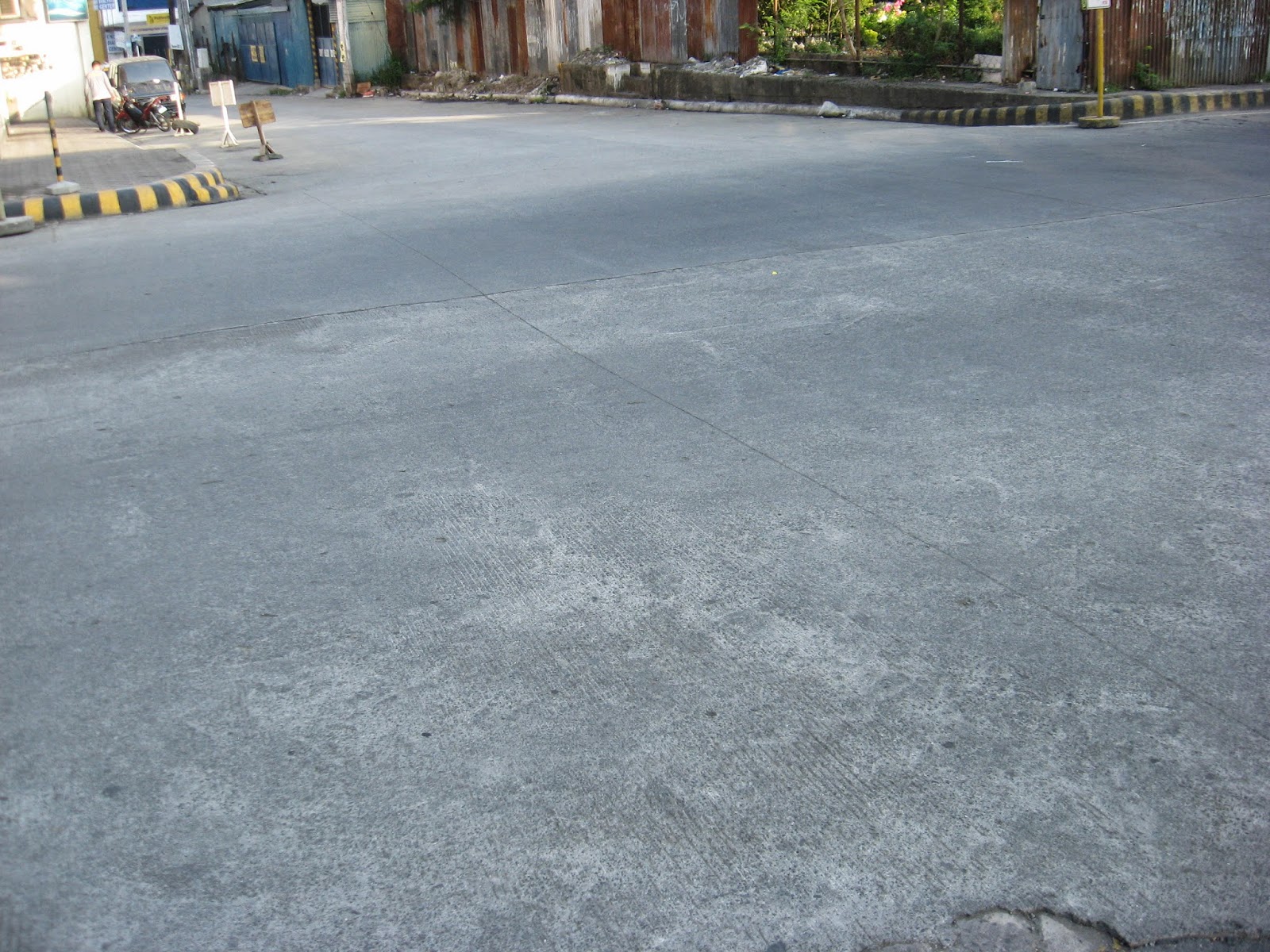
What stood out in observation was the stark absence of pedestrian lanes or crosswalks, except for one very faded and almost completely-erased one across A. Velez Street in its intersection with Hayes.

While Divisoria Park gets most of the current attention for the city drive to bring law and order in our streets, hardly any is given to the surrounding areas.  At least that is what we noticed, apart from the retinue of RTA personnel during critical hours during the day.

This to me is a big travesty, or less harshly, a big oversight, or maybe a very glaring sign of the shallowness of the city drive for orderly traffic.  It is earnestly hoped that this is not likened to a PR stunt or that this administration is just going through the motions of showing nodding compliance with certain election promises, as others would allege.

We expect pedestrians to follow a few simple rules in the use of our streets, like making use of pedestrian lanes, while at the same time we blatantly neglect to provide simple pedestrian lanes in streets around this park.  This results in total confusion, as we are wont to see in these streets.  To the point that penalty-averse pedestrians have to ask RTA personnel where to cross in the absence of lanes.  And yet we emphatically bring forth the notion of and law about jaywalking.    Talk about conflicting or confusing messages.

Thus, on the positive side, wouldn’t it be nice if the city in cooperation and coordination with the affected barangays in the area, could address the issue of absence of pedestrian lanes in these crucial intersections?

For one, our barangay eagerly waits for any inspiration and guidance from our city administrators.   We eagerly await for their first move and I am confident that we are ready to assist.  Please show us the way.

To supplement the above video, here is a picture gallery below as the walking tour continued to complete the roundabout walking tour:


Thursday, October 31, 2013

Election Vote-buying, Philippines style


To lump together any transfer of money from candidate/politician and/or his leaders/henchmen to voters as collectively and simply vote-buying I believe misses some finer points that may be unique to politics, Philippines style.  Yes, Philippines style, especially taking into account culture and the pervasiveness of poverty.

Consider the following wrinkles, or nuances, or refinements, or however one may call it, uniquely common in maybe many underdeveloped countries exercising democratic rule.

Money changes hands and given to a candidate/politician’s committed voters/supporters whether for services rendered or simply because it is election time and everyone expects money to be dispersed.  Would that technically be called vote-buying?  And how does one buy something it already owns? For many the services to be rendered would be that as poll watchers, errand boys, or other menial jobs.  And the issue is not whether or not these are redundant or unnecessary jobs. Or whether we can even truly call these real jobs.  But these are paid employment created during election time. In many instances, money transfers hands after the election and counting has been completed.

The conventional wisdom around town and elsewhere is that because of extreme and pervasive poverty, a good sure-fire enticement to vote is financial.  Thus it is not uncommon for voters to receive money not just from one candidate but usually from two or more.  In our logical mind, the differences in the amounts given would determine where the votes would go.  But this is not necessarily the case.  We have often heard political purists say that voters especially those in penury ought to accept the money and vote with their conscience.   And this may be true in many cases.  Of course, also true is the scheme where opposite parties will pay committed supporters of other parties, for them to stay away from voting. Thus, paying for non-votes clearly equals vote-buying.  Ironic?

The proof of this pudding?  Consider the very high voter turnout even during barangay elections. Small barangays in the last election registered as high as 81% turnout.   What galvanizes a citizenry already carrying the heavy onus of privation to come together and attend to a cumbersome exercise?   Money.

High elective officials may also choose to take the role of patrons for lower-level candidates and dispense money not directly tied to any particular vote, but simply as assistance or goodwill money expressly intended for the recipients either for their own particular campaigns, or different advocacies, or other commendable causes, etc.  The politician himself may not even be in any ballot. Again, would this be technically characterized as vote-buying?

The greater moral thorn of course is where the big money is coming from and/or how the generous dispensers of largesse expect to recover the big expenditure?  Every thinking man has the answer. 

But does he have the solution?  Realistic one(s).