Friday, July 31, 2020

A Prophecy of Doom! ...And Hope.


I browse around ubiquitous social media and the many news sites scattered around, and I find one prevailing thread amidst all the wanton physical chaos and caustic rhetoric strewn around. It is the rearing ugly head of evil incarnate that is hate, and that it afflicts, and maybe even kills (one is spiritual), more than this COVID 19 pandemic we are facing could ever. In both cases, technology allows the spread of their contagion at faster pace than any time before.

And addressing more on certain powerful people emanating from different strata of society.  It is almost unconscionable to learn what they would go through to publicly lie about or misrepresent what they say and do.  All in the name of hate and the underlying grab for power.  The angry anarchists both in power and on the streets!  Both those nicely dressed and suited and those masked rioters creating mayhem in the streets.

And so rather than being reticent when not being able to say anything good, the reverse becomes the truism.  Not to miss any opportunity to denigrate anybody you loathe, in dogged pursuit of an agenda tightly couched in the quest for power and influence.

The art of language, communication, and conversation has been thrown to the dogs. It has been subtly subverted – to revile people, to mislead people, and yes, to taint the very air we breathe.  And we are all the worse for it.   So how many otherwise gentle people now hate because they have been fed with false narratives?  The developing formless blob has evolved into the mob.  So how different is it now compared to the darkening times of Christ, when otherwise gentle people were transformed into an angry and cruel mob?

God help us. 

If we are believers of biblical accounts, we know that during similar godless times, God was disposed to bring wholesale catastrophe to our lot.  But he did promise with the advent of Christ that He had relented in the use of such extreme measures.

What then can we expect?

The reflex or default act of many has been a loud call to prayer.

But I say that many do pray, but they still miss the essential meaning and power of prayer.

One prays for resolution of vicissitudes because everything is dependent on God.  But the more important part of prayer is to act on those resolutions like everything was dependent on us.  Our salvation then is in us, measured in our actions under the proper guidance of Christ.  

Wednesday, July 29, 2020

In Memoriam: Graciano (Nonong) B. Neri


 He has been gone for three years now.  But the memory lingers.  I was one among many who spoke after the Mass celebrated prior to his interment.

Because of the frenzy and exigencies of the moments, I doubt anybody if any remembers what I said then.  I actually printed out what I read for my part.

Found the note, and will now write it out in a blog entry as permanent testimonial to a life lived in close proximity to mine.


0000000000000000


“Any man’s death diminishes me, because I am involved in mankind, and therefore never send to know for whom the bells toll; it tolls for thee”
This is a quote from poet, John Donne.

Words we have often heard said.  Nice-sounding and inspiring words. But what exactly do they mean to each one of us?

Graciano Nonong Neri, Jr. died a week ago and we are here gathered to help send him off to a life hereafter.

In the following narration, I try my best to put personal touches to those inspiring words above.  To show how Nonong’s passing diminishes me because he was involved in my life.

More than just being first cousins, both our families were unusually close to each other, due to certain special circumstances.  This very intimate closeness made for many shared experiences, of joys and jubilation, of mirth and merriment, of sorrows and hardships.

Both families tended to do things together.  The children practically growing up together, planning and doing things together.  Going to picnics together, taking trips together, going on vacations or out of town trips together.  More like two families fused as one.  Since Nonong’s family was more blessed materially, one could say that in many of those joint activities we were more the beneficiaries rather than the benefactors.

Taking Nonong out of the equation then means simply and outrightly taking away those revered memories from me and making them vanish in mist, since Nonong was an integral part to all of them.

So from the time that I became self-aware as a person, living in the retiring hometown of Cagayan de Oro, it has been difficult for me to imagine events and occasions during my growing-up years without Nonong and his family somehow figuring in them.

During hot summer afternoons, we went riding with horses in and around the Provincial Capitol grounds.  On other occasions, we planned extended trips to Taguanao, again taking horses with us, aside from ample provisions for overnight stays.

During family gatherings, parties, and restaurant sorties, Nonong and his trusty jeep figured in helping family members to and from the different venues they were being held.

During college years in the same school, there were instances when our associations were more than just being cousins.  One time we tried our hands in campus politics, and vied for elective positions together.  And yes, Nonong was with me when I first paid a visit to a local girl we had spotted earlier.  So riding tandem in my motorbike we went together to face the girl’s family who was residing in the poblacion.

And there were even hazardous and dangerous errands we both had to undertake, like taking a boat and flying on an old and rickety plane, hopping from one Visayas island to another, bringing with us cash resources to an aunt who had a critical need for them.

And there were countless other occasions when we partnered together, again sharing memories that cannot be rent asunder without somehow making them disappear from me.

Thus, I say his sudden passing certainly diminishes my life.

And I can only bid him Godspeed till we meet again.  Till then, Nong.

Friday, July 24, 2020

Digging Deeper into Childhood Memories


Of waving green balili grass undulating with the wind.  Of quaint nipa huts with dirt floors.  Of bitter-tasting rain water as drinking water from an earthen banga, fed and replenished by rain flowing from the nipa roof.  Of dusty rolling streets where noisy kids paddled their rickety rubber wheels, up and down.  Of a decrepit panaderia at the bottom of the road.  Of an old lady named Inoria resting in her creaky lantay, selling the most delightful bread and pastries a child could hanker.  Etc.

Of these are the itchy splinters that keep resurfacing, as I recall distant time of youth in the bosom of then enviable Cebu City, in the colorful milieu of my mother, her mother, and their relatives.  Mostly of renowned birth, but quite simple and unpretentious in living style and quarters.

My mother originated from old Cebuano families with roots that dated back to early Spanish times. My father who was himself from old Cagayanon families married into that.  Thus, as kids we had spent time in both Cagayan de Oro and Cebu.  While I was already born in Cagayan de Oro, my elder siblings were born in Cebu.

As such, part of my early youth was spent in Cebu and these recollections partake of that part of my growing years.  Of times when we vacationed in Cebu in my grandmother’s house located close to the intersection of old Sikatuna St. with D. Jakosalem Street., a rather quaint section of the city with narrow lonely streets then as now.  We lived intimately nestled close to relatives of my mother.  That meant most of our neighbors then were close relatives, and thus we lived in a small community of extended families.  All this spelled happy and lively times of camaraderie and laughter for the many kids around there.

Thus I reminisce of cool afternoons, just roaming around with other kids inside my grandmother’s homestead which was essentially an empty lot save for the two diffident huts, blanketed by tall green balili grass waving in cadence with slow breezes of the afternoons.  And we kids would just romp and play, tumbling and horsing around not really minding that later on our bodies would get itchy from the grass.  But as kids we frolicked in gay abandon.

My grandmother’s house was situated closer to the lower end of the road downgrade which originated from D. Jakosalem St., set back a bit from the road.  A little bit up but closer to the road was the even smaller house of my grandmother’s little sister, Lola Pepang Ramirez.  Both houses were close enough for conversations to be carried with ease between the two places.  And these modest homes paled in comparison to the size of the lot that grandmother owned.  And she also possessed more real estate in other parts of the province.


My grandmother’s house was a very retiring nipa hut with dirt floors, though the bedrooms may have been a bit elevated and thus had wooden or bamboo floors.   I do not recall our having electric lights then, nor indoor plumbing.  We had drinking water coming from a banga that was fed with rain water coming from the roof.   My grandmother being widowed early, I do not have any recollection of my grandfather.  Similarly, her little sister was also already widowed when they lived close to each other.  One significant thing I do remember what my grandmother busied herself with after her prayers which spanned throughout the whole day was that she was so attached to sewing and darning clothes.  And she was so good at it in detail and symmetry, that the result looked like they were done by machines.  This I can easily recall because I used to watch her often.  And this experience I believe may have also gotten me interested and into sewing and darning clothes.  And this acquired skill has done me good up to this day.

In this rustic environment, we spent whatever little time we garnered during our not so often vacations to the land of my mother, embraced by a tiny neighborhood of good-looking relatives, a welcomed result of an admixture of different ethnic hues obtaining in that place. From Spaniards, to Chinese, and other mestizos.  Grandmother’ stock was considered Mestizo Sangley, and her husband was most likely with Spanish blend.


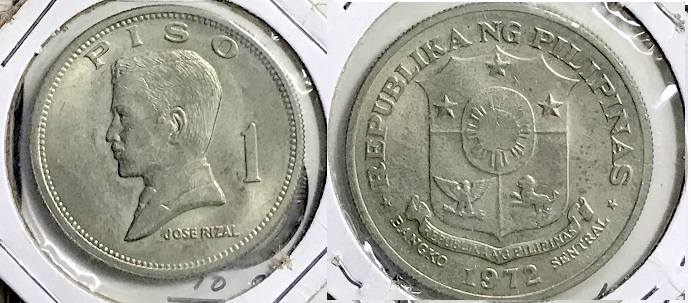
Philippine Coinage


Philippine coinage is quite distinct from the rest, having thrived in 3 different worlds.  First from its Spanish colonial tutelage that lasted over 300 years, punctuated by 40 odd years of American rule, until 1946 when it was granted independence and had to learn to live on its own under a republic.

And oh what a ride it had been, leaving behind a treasure trove of memories and artifacts whose discoveries and collections could last lifetimes.

Beginning in the 1500’s Spain held away in the islands, and like true colonial powers then tried to suck dry the islands’ treasures and resources to pleasure the kingdom’s imperial elites and their prodigal tastes.  But like lazy imperialists, it never really tried to develop a distinct and separate identity for the archipelago, though it was named after one of its kings, King Phillip.  The Spanish currency system simply got extended to the islands, and beyond that, Spanish citizens intermingled with the rest of the population.  Making only one distinct imperial caveat.  If you were born in the mother country you were referred to as peninsulare, and insulare if born in the islands.   Anyway, the natives were thus blessed with the coinage of the realm sufficient to declare it as also their own.

At the turn of the 19th century, the Americans came, via a one-sided war against the colonizers, and then pitted against the hapless natives, and ruled the islands with relative ease for some 40 odd years.  This time establishing a separate coinage system for the islands to give it distinct identity, though still a vassal of the new colonizer.  And wonder of wonders, the US established in the islands, the only (up to this day) mint located outside of continental US of A.  It was called the Manila mint and operated until the islands’ independence.

Then came 1946 and independence.  Since then, the republic has taken over its coinage, until the present time

Tuesday, July 21, 2020

Oligarchy in the 21st Century


 Unable to present credentialed bona fides, I take a rather simplistic and layman approach to the issue of oligarchy which hot topic has been trending not only locally by even in places like the US.

First of all, I take oligarchy simply to mean rule and influence of a few over others.  For simplicity’s sake, currently I take it to encompass four major areas, political oligarchy, economic oligarchy, academic oligarchy and media oligarchy.  The four do not necessarily reside in the same group, though invariably these vested interests are in close cooperation and share common interests.  And are deeply bound by affinity and unanimity of anointed goals and ideologies.

With this kind of generalized premise, we find this unholy situation in most parts of the globe, however shallow or deep in their stages of development certain places are.

In their numbers, we can identify and sort the many-flavored elitist groups that hold collective power and sway in the realm of business and government, and the polity.  They define their respective turf, enhance and fortify them, and wage battles over each other when threatening moves are made over their defined spheres of rule.

When certain members of one particular group are eliminated or curtailed, others take their place.  The powerless, non-minded and disjointed majority are left as awed spectators to observe and take sides to get their yeoman share of the crumbs thrown around.  They curry favors from these masters, unable to marshal forces and resources to fend for or survive on their own.  Sometimes they follow or are led blindly, fed with convoluted narratives that when exposed are divorced from realities and deleterious to their own common interests.

And this is basically how we find the world today since as far as memory allows.  And the cycle goes on and on, and unbroken.