Tuesday, November 29, 2005

In Memoriam: Nilda Neri Veloso

NeriSisterss1
(Nilda Neri on the right)
During the funeral services in Baybay, in Southern Leyte, I was asked to deliver a short memorial for my late aunt who was buried last November 12, 2005.

This entry is intended as a more or less permanent memorial of or testimony on the life of the deceased. Any relatives and friends then who chance upon this blogsite are invited and encouraged to lend their own words under the Comment section of this entry.

Thanking you in advance.

I am one of the sons of Amadeo R. Neri, an elder brother of our late departed aunt, Nilda Neri Veloso. I, my brother Philip, and sister Esper, who are here with you today on this most solemn occasion, are all originally from Cagayan de Oro, the same place where Tia Dedith, or Nilda to many of you, also first saw light.

With her death, we have witnessed the auspicious passing of the last surviving sibling of my father's family. And I understand the same is also true on the Veloso side.

Tia Dedith's passing marks a significant milestone - the complete transfer of legacy from one generation to another. We could say, the passing of the proverbial torch to the next generation.

Relatedly, this aspect of her passing has also been quite a revelation for me personally. Our waking up one day to confront the knowledge that we are now the older generation. That many of our cherished elders have passed on, leaving us veritable orphans.

Regarding our own unique and special relationships with Tia Dedith, these are what I can say based on my best recollections.

For most of us brothers and sisters, growing up in idyllic Cagayan de Oro during the early 50's, we may be able to say with one voice that we share the same recollections of Tia Dedith.

To us, Tia Dedith was an aunt we saw only on quite rare occasions. We formed our images of her as the youngest and best-looking sister of our father, who married an important person from Baybay. That with her husband, she split her time between Baybay and Manila. In due course, of course, we learned that she had married our late Tio Minggoy Veloso, who in his political career went on to become Speaker ProTempore of the House, aside from presiding over and tightly operating a thriving shipping business.

The rare visits of Tia Dedith to her old hometown were always welcomed and eagerly anticipated events by us, her nephews and nieces. And because of her vaunted generosity which reputation preceded her, we kids may even have regarded those visits as Christmas times for us. Since we wasted no time milling around her and doggedly continued on till our hands or pockets were filled with our generous shares of her pasalubongs.

Tia Dedith always rose to the occasion, leaving us with kind and lasting thoughts of her generosity.

When the years passed and we had developed our own travel wings, my brothers and sisters got the coveted opportunities of being able to visit with her in Manila. And at times stay with her as her non-paying quests in her hospitable house in Cortada, Ermita. Two older brothers even worked for them for some time. And as I learned last night, even my father was allotted office space in Cortada for a time.

In fine, we collectively got to know Tia Dedith better, through these intimately close contacts.

And as more years passed and the number of her surviving siblings dwindled, we individually got to know her even better - from her occasional visits to Cagayan to attend the fiesta and in turn from our visits to her in Baybay from the time she got widowed.

Today we are paying our last visit and our last respects to our last connection to our parents' generation, and eventually to that part of our past.

We take this once in a lifetime opportunity then to reflect on the long life of Tia Dedith and longingly offer her back to her God's warm embrace, laced with our equally loving testimony on a life well lived.

A life quite deserving of honor, respect, and the eternal reward promised to each one of us.

May God bless us all.

Saturday, November 26, 2005

A Little Bit Of Back To The Past

If one rummages through one's spent youth, what would one find in the attic or closet?

Invariably, one could find a typical assortment of discarded trinkets, old-yellowed scrapbooks and yearbooks, maybe some once-invaluable toys. Some science projects that got honorably mentioned maybe? Or little art objects created and molded by one's little clumsy hands? Maybe some remnants of a philately or a numismatist collection rendered inactive many years ago?

Well, maybe all that and more.

But would one typically find objects that required endless hours to create and prided then as great beauties deserving of some enviable place in one's little room and eventually in the cavernous hallowed halls of one's memory?

Maybe little inconsequential objects that could be likened to currency or legal tender, or even antiques, because they now possess intrinsic values frozen in time and residing in them?

And for me personally more than just invaluable memory stored in them, the strictly financial aspect of countless time invested in them, debited and withdrawn from the finite number of hours in one of life's crucial phases which we call youth.

And this is exactly what I felt during one of my trips back to the old homeland and discovering in some obscure corner of the old house that I used to call home, some of these objects that used to occupy and consume my youthful idle time with such serious vigor and passion that at times made me oblivious to time and its many youthful allures

I well remember that armed only with a several lead pencils (they were actually made from graphite) and ordinary manila folders or any blank pad available, I would sequester myself in some quiet and secluded nook, and with nose to the grind, be completely lost in the creation of those objects.

Now I wonder if I had wantonly misspent so much of my youth on such petty pursuits. And worse, because a good many of these objects have become hapless victims of time and humidity. The little unseen things spawned by the blistering humidity of a tropical place have ravaged many. Realized too late that those little insects (?) could make happy meals out of shades and lines created by lead pencils, leaving only as left-overs the paper they were etched into.

Anyway, discover them I did. And floods of memories immediately rushed out like careening waters from a broken dam. And before assigning them back to oblivion, I now commit pen and space to reliving those then priceless memories

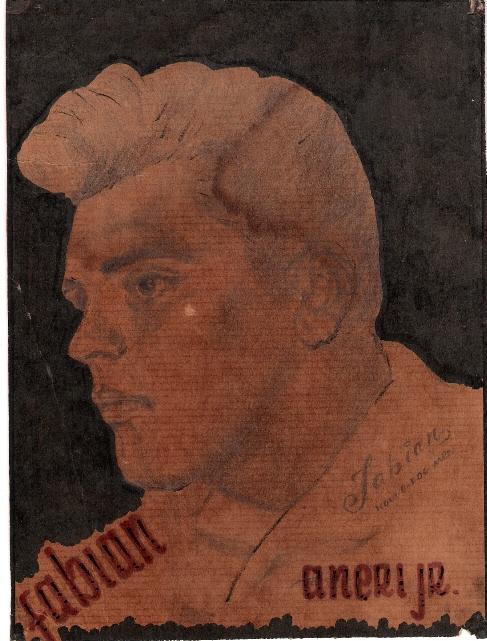
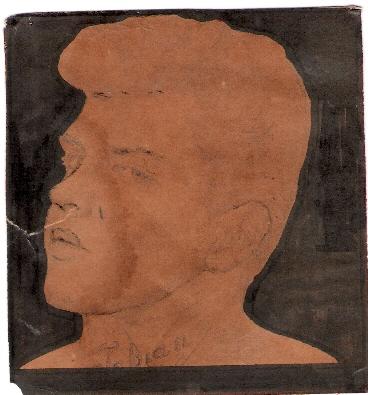
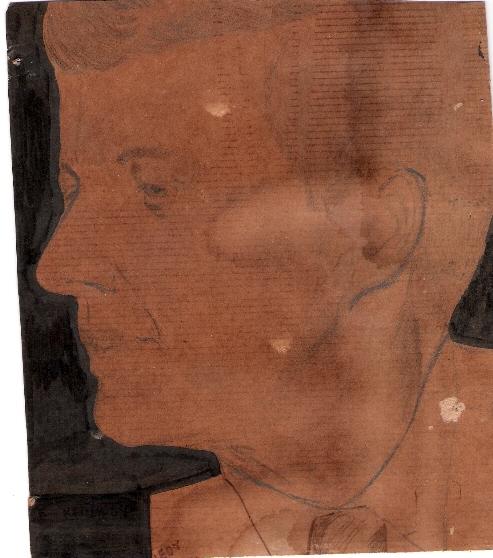
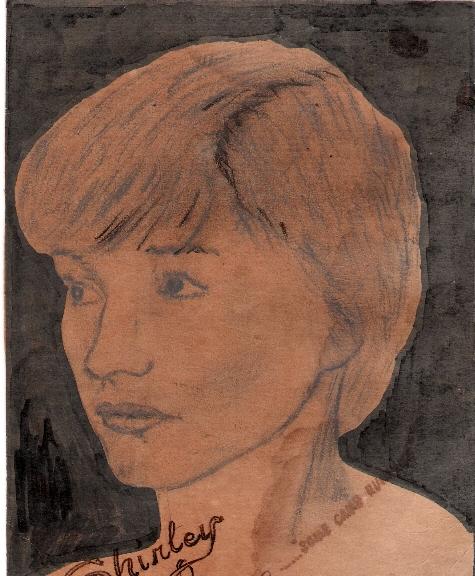
Oh, by the way, these objects are drawings or sketches, strictly of people's faces, heads only.

My favorite subject was the Greek god-like features of Elvis Presley, who was likened to old filmdom's great profile, John D. Barrymore. It was such an easy pleasure etching on paper the prominently chiseled features of the late great rock and roll singer, with his deep-set eyes, full-blown pouty lips, great pompadour, etc.

Several of my drawings of him were saved from completely being lost. Here are those that were spared:


On the distaff side, now old and craggy Liz Taylor was the darling, not only with the puzzling eyes that change colors, but again with the perfectly chiseled features earning for her the title as the most beautiful woman of Hollywood and beyond. Here's a couple:


A little bit of ego played in it too, so here's a self-portrait:


The wife figured in it, too, feeling quite compelled to include her in the odd collection though at a much much later period:

Now, I recall several sketches of pretty local girls were gifted to their admired subjects.

The other sketches quite dutifully followed both the usual shallowness and profundity of youth, both in its crassness and idealism, its zany-ness and logic. There's John F Kennedy, local movie idol Jose Mari, Shirley MacLaine, B-actor John Saxon, clean-cut Pat Boone, talentless as a singer but beautiful Fabian Forte, local star Lourdes Medel, and Bing Crosby's youthful wife Kathryn, etc.


Lastly, harried restoration work was attempted on those saved using the much darker imprints and shades of charcoal pencils. The sketches then are not how they looked originally. And with the scary results, it may have been a great mistake to retouch them in the first place.

Oh, well!

Sunday, November 20, 2005

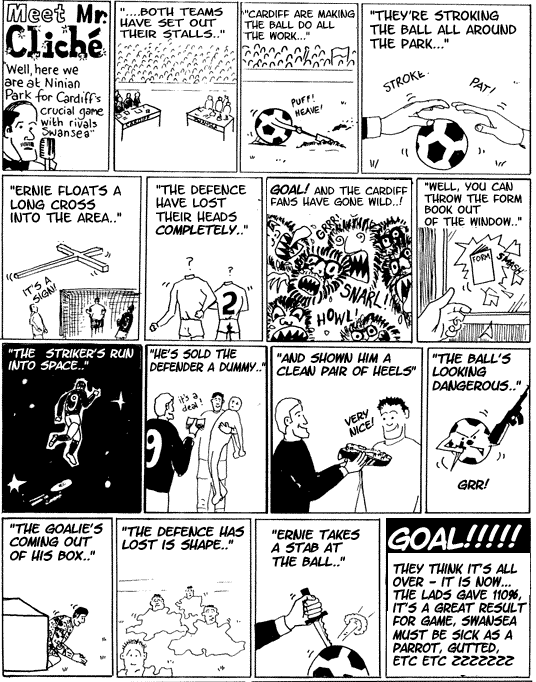
Are We Inveterate Cliché Users In Our Blog Writings?

First, what are cliches?

Loosely, these are trite phrases or hackneyed expressions. Sometimes called bromides, which are commonplace statements or notions. But being a word derived from French, we may have to seek expert advice from a Frenchman for the word's specific connotations. But the English language appears quite comfortable with its own connotations.

Well then, test yourself and find out how unconsciously we have all become virtual slaves to cliches that have been with the language since time immemorial.

(Well, what do you know? Time immemorial. That should be a time worn cliché. Time worn. Another one?)

We can build essays or concoct conversations without maybe being aware of the cliches used.

Below are passages, sentences, etc. lifted from various sources and littered with innumerable cliches.

Read and take notice.

Writing about cliches is an uphill climb, because doing so is no bed of roses.

Most common are seesaw cliches. As your self-appointed cliché collector/guru, I had my ups and downs. Sometimes, when everything was at sixes and sevens, it almost seemed as though as my dearest ambitions were going to wrack and ruin. I had moments when I was almost tempted to believe that everything was a snare and a delusion. Even my own flesh and blood discouraged me, in spite of the fact that I was their pride and joy. Or that my own kith and kin disparaged me.

For a considerable period of time it was nip and tuck whether I would sink or swim. If I had not been hale and hearty, and well equipped for a rough-and-tumble struggle, I wouldn't have come through. But I kept at it, hammer and tongs. I gave 'em tit for tat. I went after my goal hard and fast, eschewing wine, woman, and song.

I worked morning, noon, and night, and kept to the straight and narrow. The consequence was that in due course of time, victory seemed assured. That is, things began to come my way by fits and starts, and a little later by leaps and bounds. Now, I feel fine and dandy.

Now, I venture to predict that no man, without regard to race, creed, or color, is a better master, by and large. And this, in all due modesty, though I think there is no rhyme or reason to it.

Now, some words about myself.

Though I was born in the altogether and on the impulse of the moment, I'd say that it was just in the nick of time. And this is straight from the shoulder, revealing to you my true colors.

Growing up, I kept trying to combine single blessedness with wedded bliss. It didn't work. I had a sweetheart in every port, and I worshipped the ground they walked on, each and every one of them.

But I was land-poor at the end and you can take the advice of a sadder and wiser man. Better not tangle with the weaker sex. But am I hard pressed for cash? No, since I am well paid. Get paid with a princely stipend in the coin of the realm. But I do not give a hoot for money. It is after considered the root of all evil.

But I don't complain. I am as snug as a bug in the rug. I'm clear as crystal - when I'm not dull as dishwater. I'm cool as a cucumber, quick as a flash, fresh as a daisy, pleased as Punch, good as my word, regular as clockwork, and I suppose at the end of my declining years, when I'm gathered to my ancestors, I'll be dead as a doornail.

I have a finger in every pie, all except this finger which I use for pointing with scorn. Which I do always with malice afterthought. My standing offers are on the table though at time at cross-purposes and in dire straits. I keep my ulterior motives to myself, though littered with vicious circles and sneaky suspicions. My likely stories are also filled with fiendish glee.

Though behind the throne, I show tender mercies and get lost in thought and at times up in arms. I am a straight shooter with my trusty revolver. My vaunted courage is famous and that is no crying shame. I have been in the depths of despair and have desired a watery grave in the briny deep. Though I eventually want to marry and settle down.

After all, I'm a diamond in the rough, too funny for words. I like to trip the light fantastic and burn the candle at both ends. And this is no sheer folly.

Can We Define The Lingua Franca of Blogging?

Blogging has become a worldwide phenomenon, transcending geographical frontiers and delimiting borders. An astounding coterie of peoples in different countries around the globe, with differing ethnic and language backgrounds, all meet in the blogosphere in intimate and understandable two-way discourses of most topics under the sun. They congregate and flourish in countries big and small, from pint-sized Belgium to gigantic China. And the global explosion continues unabated exponentially.

But what would be the lingua franca of blogging, albeit unofficially?

A little review of the not too distant past might help us arrive at some consensus of an answer. For its birth as a new medium, blogging arguably owes its origins in the US. After all the words, weblogs, and its contracted form, blogs, were a creation of one of its own citizens, living close to technologically predisposed Silicon Valley in Northern California. Another US citizen gave us the word, blogosphere.

Understandably then because of its longevity, it is the US blogs, in most discernible categories, that are more sophisticated, widely read, and have become primal models for the rest of the world to track and follow. Most of the technologies now fueling the proliferation of blogs likewise owe their origins in the US. The top companies selling/leasing or making available the resources and media to create and maintain blogs are based in the US.

No doubt, there are blogs out there that are written in the authors' native tongues and are thus intended sectorally for those familiar with the languages. But we can deduce that the more popular and more respected ones are the ones written in English, whether they be authored by native-born speakers of English or by those whose multi-linguistic orientation allow them to also communicate using the King's language.

I well remember the widely read and eagerly anticipated Iraqi Raed who while in Baghdad during the onset of the current war, risked all to be able to update his blogs about the blistering bombing raids. All this in perfect English. Some respected blogs in the US debate relevant issues with their counterparts in countries in Europe, such as Belgium and Liechtenstein. Again using English as the medium. Many Asian countries, like the Philippines, can boast of cadres of blogs all written in either very good or at least understandable English, since at times entries are interspersed with the local languages or dialects. One can also spend time googling about blogs and their entries and the results would invariably show not only how geographically dispersed the blogs are but also that most of them are written in the locals' versions of the English language.


So is the answer: American English?

And written American English, to be specific?

I had to resort to re-reading old textbooks to arrive at some informed and adequately reasoned notions about this language we all call English.

I bet you not too many are familiar with the discussions on which of the two, spoken or written, exerts more weight on how and where the English language evolves or drifts.

We may not even be sure if there is one global entity called the English language, given the very many local dialects of English far removed from its origins which date back to pre-colonial times in the England of antiquity. There are many native-born speakers of English in many communities and countries, each distinctly speaking their own local versions or dialects of English. English-speaking USA has scores of dialects of English scattered throughout its many regions.

But first let's settle which is the egg and the chick in this dilemma. Many authorities point to spoken English as the primary determinant of language, giving it its grammar, syntax, pitch, tune, phrase, word meanings, etc. Written English is only some 2000 years in existence, but spoken English dates back to great antiquity. And many preach that spoken English grows with the speaker as he matures, interacting with the small circle that defines his environment - family, friends, community. It is this rather limited environment that defines for the speaker the kind of language that is integral to his existence, language that for him and like-minded speakers is the correct and appropriate form and usage.

So, indeed there is American English, though in reality many local variations of it culled from many distinct local flavors of spoken English, from the northeast, to the south, to the west, and those in between.

There is nothing to suggest however that there is one standard American English, fixedly determinate, definable, and monolithic.

And this conclusion could be tenable if we can discuss and accept the five simple facts about language that many liberal-minded linguists appear to agree on.

But first it must be noted that this viewpoint is not looked upon too kindly by those more conservative purists who consider language as fixed, assigned specific and permanent values in their original usage, and who generally consider changes in usage or locutions as unacceptable, implicitly comparing language to the tenacity and unchanging nature of moral absolutes.

The first simple fact is that language is basically speech. And we have shown why many adhere that spoken English is defined by the speaker in his little community, apart and distinct from the rest of his country. This is not to say that written language has no influence at all in his language, just that the influence is minimal or accidental.

Second, that language is personal. It is the experience and patterns of habit that are very intimate because it is only the sum of the individual's experiences, which is not expected to acquire all the wealth that a copious language can offer. And we are at one with the rest of the country because of our easy command of our own hometown's pitch, tune and phrase

The third fact is that language changes. It can change in sounds, meanings, and syntax, from one generation to another. While these changes may at times be imperceptible and imprecise, they can add up in time to perceptible changes and eventually to noticeable drifts.

Fourth, that users, one way or another, are isolated. Users maintain familiar and comfortable relationships that unite them into one language community. Isolation comes in many forms aside from just distance. It could come because of education, of economic status, of occupation or profession, age, sex, etc. Sometimes, these forces can exert greater influences on languages than oceans and rugged mountain terrain.

And fifth, language is a historical growth of a specific kind. True, the nature of English is akin to the laws of physics or physical reality. English simply is. But it changes much like physical reality. Land mass changes and geography is what it is today because of the geologic upheavals of the past. The same is true of the language of English.

The blogosphere has made possible certain assumptions:

a.Since it is essentially a medium catering to the written form, it goes without saying that because its use and patronage has become very pervasive and influential worldwide, the written form of the language, and in this instance, English, will in the future determine to a large extent how the language itself will evolve, grow, or change. Especially as a global language.

b.Secondly, the very phenomenon of the Internet has broken down physical barriers that used to impede the development and spread of language. The planet has become one global community and more particularly in this respect.

These developments then would tend to make irrelevant some if not all of the accepted basic facts of language enumerated above.

Are we then near the time when one global language will be determined, agreed upon, and assigned fixed values and meanings, for universality of form and usage?

Regardless of where this is heading to, English continues to be the language of choice in the blogosphere.

Wednesday, November 09, 2005

Dahilayan Barrio: Eden At Your Reach?

After a protracted stay of over a quarter of century, it might come easy to decide that the US, especially sunny California, may be the yearned-for paradise away from any old hometown ensconced in a third-world country like the Philippines - hot, humid, underdeveloped, and, crowded with a lot of people I personally felt quite alienated from in terms of common interests and values.

After much thought and soul-searching I did come to the conclusion that my new adopted place was the place where I would like to spend the rest of my life, specifically the San Francisco Bay Area. Home to the fabled Golden Gate Bridge. Blessed with a most hospitable climate the whole year round, and equally blessed with the most interesting and amazingly cosmopolitan people one could find in the entire globe. Not to mention all the given comfortable accoutrements that go with living in a first-world country.

This resolute resolve had always shadowed me, even on the countless visits made back to the old homeland, the last one lasting for 3 months. At the back of my mind, I could always console myself with that comforting thought, especially when besieged by nagging difficulties during the visits. Such as the intolerable heat and humidity, the atrocious traffic, ubiquitous squatter areas or shantytowns, and more. I knew that I could always sidle back to my safe haven when the visit ended. Nothing that a quick return plane trip could instantly dissipate.

And I had always felt that nothing could drastically alter that steely resolve. But I missed to reckon that I have always been stubborn and obstinate. Label me as the guy who keeps repeating to do things until the desired results come out, unheeding conventional wisdom's admonition that those who keep repeating endlessly an action even though the desired result is not accomplished may be judged as crazy.

Thus, I had never given up the exercise for finding tenable reasons why the old homeland could be just as "good" as the acquired earthly Eden that one has usurped in moving to another country.

This had led me to the cold and calculating process of listing all the reasons why the adopted place had been considered as the perfect nest to spend one's twilight years. And matching them with acceptable alternatives in the old homeland. No stone was left unturned. Even imagined reasons got thrown into the mix.

The process has been both lingering and tedious to say the least. And after a long and hard look, some things appear to gel, determinable and recognizable but still quite hazy. But I subscribe that like most things in life, nothing is ever cut and dried, black or white. Hard fought decisions are usually arrived at based on imperfect methods, insufficient data, and yes, less than 100 percent clarity and surety. Thus, most decisions result from some combination of logic and rolls of the dice.

The same is definitely true with this comparison match-up between the old and the adopted homeland. The comparison itself has been done in a rather unorthodox manner, given that comparing very diverse locale is in itself quite subjective and values assigned rely largely on personal perception and bias. I suppose that if one looks hard enough for reasons, one will ultimately find some.

Of all the places that I have traveled in my youthful years and during more recent times, I have pinpointed one such locale that to me could comparatively match up with the one decided upon in the US. And that choice hinges on the following criteria of climate, its ability to sustain lifelong interests and avocations, accessibility, economic viability, and maybe such factors as familiarity with customs and culture. Biggest drawbacks are its distance from the rest of our immediate family, the deplorable economic and political situation in the country, and maybe the economic trade-offs inherent with living in a third-world country.

Anyway, all things considered, my choice has been the little, agricultural, remote, and rural barrio of Dahilayan, in the municipality of Manolo Fortich in the Province of Bukidnon forming part of the northern region of the island of Mindanao.

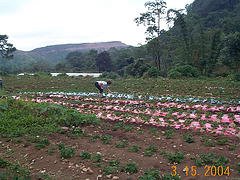
For the past 3 years or so, we have been slowly and quite imperceptibly acquiring contiguous farmlands in the above barrio which rises some 1300 meters above sea level and nestled in one the various foothills forming part of the majestic Kitanglad mountain range. The imposing shadow of Mt. Kitanglad looms large and inviting facing south from where we are located. The combination of soft rolling hills and sharp steep inclines in the terrain while at times providing daunting challenges in farming, makes for a landscape that can combat boredom and cookie-cutter looks in farm lots. No endless stretches of uniform looking plots or bland flat yards around structures.

And no fears of being isolated from the rest of civilization, since the place can be reached from the bustling northern Mindanao city of Cagayan de Oro in an hour or so, though the conditions of roads at times leave much to be desired. Especially during rainy seasons. But the eye-catching travel scenery makes up for this lack of comfort, traversing through verdant fields of pineapples, vegetable tracts, and simply virgin valleys and gullies enveloped in thick foliage. Intermittently broken up with sites of man-made structures such as greenhouses and even piggery housing. But the overall outlook of the area is still one of being untapped and unspoiled by too much intrusion of urban-like sprawl and structures.

We must also point out that the area is part of the now 25,000 has. being cultivated by Del Monte's Philippine Packing Corporation for its now varied operations. In earlier times, PPC's main product was canned pineapple. Thus an added bonus to those inclined is the famous Del Monte links some 20 minutes away from the barrio, where golf enthusiasts, both local and foreign, are wont to visit when in the area.

Agriculture in its many manifestations and variations has always been welcomed and blessed in most areas of Mindanao, which boasts of its nature-given gifts of good fertile soil and suitable climate. Thus, earning for it the dual distinction of being a rice granary and vegetable bowl of the country. All this of course, prior to the current ethnic and social unrest now endemic in most parts of southern Mindanao, where unfortunately agriculture is most suitable and once most thriving. Now pervasive poverty, widespread ignorance, and the many horrible ramifications of both are the daily realities in most provinces, where most relevant statistics are skewed higher compared to national figures.

But for this chosen barrio one of the biggest factor in its favor has been the climate, cool and temperate and almost at direct odds with the heat and humidity in the low-lying cities and towns that dot the coastal areas. And as I personally note, most like that of the San Francisco area, complete with the morning and late afternoon spectacle of white-mist fog. Nothing like the surreal ambiance brought on by nature's little cat feet (as Carl Sandburg intoned) to bring on grand and profound thoughts.

And quite integral to all the thicket of personal preferences, there is for me the added underlying purpose of the place to promote my thoughts and plans for helping this blighted land through essential agriculture pursuits, which after all has been from its existence its anointed soul and purpose.

To raise a small hand in the entire island's drive to gear up and go back to its roots which today remain stunted and neglected, that is now my focus.