Friday, July 24, 2020

Digging Deeper into Childhood Memories


Of waving green balili grass undulating with the wind.  Of quaint nipa huts with dirt floors.  Of bitter-tasting rain water as drinking water from an earthen banga, fed and replenished by rain flowing from the nipa roof.  Of dusty rolling streets where noisy kids paddled their rickety rubber wheels, up and down.  Of a decrepit panaderia at the bottom of the road.  Of an old lady named Inoria resting in her creaky lantay, selling the most delightful bread and pastries a child could hanker.  Etc.

Of these are the itchy splinters that keep resurfacing, as I recall distant time of youth in the bosom of then enviable Cebu City, in the colorful milieu of my mother, her mother, and their relatives.  Mostly of renowned birth, but quite simple and unpretentious in living style and quarters.

My mother originated from old Cebuano families with roots that dated back to early Spanish times. My father who was himself from old Cagayanon families married into that.  Thus, as kids we had spent time in both Cagayan de Oro and Cebu.  While I was already born in Cagayan de Oro, my elder siblings were born in Cebu.

As such, part of my early youth was spent in Cebu and these recollections partake of that part of my growing years.  Of times when we vacationed in Cebu in my grandmother’s house located close to the intersection of old Sikatuna St. with D. Jakosalem Street., a rather quaint section of the city with narrow lonely streets then as now.  We lived intimately nestled close to relatives of my mother.  That meant most of our neighbors then were close relatives, and thus we lived in a small community of extended families.  All this spelled happy and lively times of camaraderie and laughter for the many kids around there.

Thus I reminisce of cool afternoons, just roaming around with other kids inside my grandmother’s homestead which was essentially an empty lot save for the two diffident huts, blanketed by tall green balili grass waving in cadence with slow breezes of the afternoons.  And we kids would just romp and play, tumbling and horsing around not really minding that later on our bodies would get itchy from the grass.  But as kids we frolicked in gay abandon.

My grandmother’s house was situated closer to the lower end of the road downgrade which originated from D. Jakosalem St., set back a bit from the road.  A little bit up but closer to the road was the even smaller house of my grandmother’s little sister, Lola Pepang Ramirez.  Both houses were close enough for conversations to be carried with ease between the two places.  And these modest homes paled in comparison to the size of the lot that grandmother owned.  And she also possessed more real estate in other parts of the province.


My grandmother’s house was a very retiring nipa hut with dirt floors, though the bedrooms may have been a bit elevated and thus had wooden or bamboo floors.   I do not recall our having electric lights then, nor indoor plumbing.  We had drinking water coming from a banga that was fed with rain water coming from the roof.   My grandmother being widowed early, I do not have any recollection of my grandfather.  Similarly, her little sister was also already widowed when they lived close to each other.  One significant thing I do remember what my grandmother busied herself with after her prayers which spanned throughout the whole day was that she was so attached to sewing and darning clothes.  And she was so good at it in detail and symmetry, that the result looked like they were done by machines.  This I can easily recall because I used to watch her often.  And this experience I believe may have also gotten me interested and into sewing and darning clothes.  And this acquired skill has done me good up to this day.

In this rustic environment, we spent whatever little time we garnered during our not so often vacations to the land of my mother, embraced by a tiny neighborhood of good-looking relatives, a welcomed result of an admixture of different ethnic hues obtaining in that place. From Spaniards, to Chinese, and other mestizos.  Grandmother’ stock was considered Mestizo Sangley, and her husband was most likely with Spanish blend.


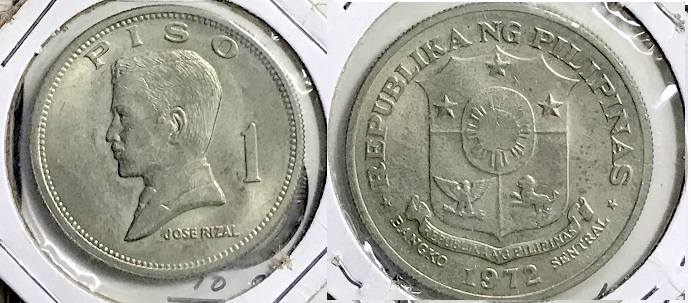
Philippine Coinage


Philippine coinage is quite distinct from the rest, having thrived in 3 different worlds.  First from its Spanish colonial tutelage that lasted over 300 years, punctuated by 40 odd years of American rule, until 1946 when it was granted independence and had to learn to live on its own under a republic.

And oh what a ride it had been, leaving behind a treasure trove of memories and artifacts whose discoveries and collections could last lifetimes.

Beginning in the 1500’s Spain held away in the islands, and like true colonial powers then tried to suck dry the islands’ treasures and resources to pleasure the kingdom’s imperial elites and their prodigal tastes.  But like lazy imperialists, it never really tried to develop a distinct and separate identity for the archipelago, though it was named after one of its kings, King Phillip.  The Spanish currency system simply got extended to the islands, and beyond that, Spanish citizens intermingled with the rest of the population.  Making only one distinct imperial caveat.  If you were born in the mother country you were referred to as peninsulare, and insulare if born in the islands.   Anyway, the natives were thus blessed with the coinage of the realm sufficient to declare it as also their own.

At the turn of the 19th century, the Americans came, via a one-sided war against the colonizers, and then pitted against the hapless natives, and ruled the islands with relative ease for some 40 odd years.  This time establishing a separate coinage system for the islands to give it distinct identity, though still a vassal of the new colonizer.  And wonder of wonders, the US established in the islands, the only (up to this day) mint located outside of continental US of A.  It was called the Manila mint and operated until the islands’ independence.

Then came 1946 and independence.  Since then, the republic has taken over its coinage, until the present time

Tuesday, July 21, 2020

Oligarchy in the 21st Century


 Unable to present credentialed bona fides, I take a rather simplistic and layman approach to the issue of oligarchy which hot topic has been trending not only locally by even in places like the US.

First of all, I take oligarchy simply to mean rule and influence of a few over others.  For simplicity’s sake, currently I take it to encompass four major areas, political oligarchy, economic oligarchy, academic oligarchy and media oligarchy.  The four do not necessarily reside in the same group, though invariably these vested interests are in close cooperation and share common interests.  And are deeply bound by affinity and unanimity of anointed goals and ideologies.

With this kind of generalized premise, we find this unholy situation in most parts of the globe, however shallow or deep in their stages of development certain places are.

In their numbers, we can identify and sort the many-flavored elitist groups that hold collective power and sway in the realm of business and government, and the polity.  They define their respective turf, enhance and fortify them, and wage battles over each other when threatening moves are made over their defined spheres of rule.

When certain members of one particular group are eliminated or curtailed, others take their place.  The powerless, non-minded and disjointed majority are left as awed spectators to observe and take sides to get their yeoman share of the crumbs thrown around.  They curry favors from these masters, unable to marshal forces and resources to fend for or survive on their own.  Sometimes they follow or are led blindly, fed with convoluted narratives that when exposed are divorced from realities and deleterious to their own common interests.

And this is basically how we find the world today since as far as memory allows.  And the cycle goes on and on, and unbroken.

Saturday, July 04, 2020

A RETRACING OF THE PLAZANS: A Personal Account: The Early Juvenile Gang Years

Consider this brash first-person scribblings of a now hazy segment of a time past. It could have relevance and would make sense only to those people who figured in and shared with the carefree bucolic times during the idyllic youthful years in the old hometown. To them this little piece of nostalgic history is addressed and dedicated.

While some may have already reduced to print or committed to writing some accounts pertinent to what might loosely be called a retracing of the Plazans, if one is earnestly serious then one has to point deeper, especially into the early beginnings of the Plazans, and it necessarily will have to go way before the word itself even got into the vernacular.

Now, to really be all-inclusive about it, we could also trace even deeper into the earlier times when many adult residents also regarded Plaza Divisoria as their favorite trysting place, an unlikely haven where they could unwind, smoke, and even feel cool during hot summer nights. And maybe more expectedly, hear or exchange relevant news of the day. And since political gatherings typically originated in the plaza areas, then the plaza too was where political Demostheneses pitted and honed their oratorical and argumentative skills with others. The name of perennial mayoralty candidate Totong Pangan readily comes to mind. Thus many old-timers can also be counted as regular nocturnal denizens of the plaza.

And what's more, there was a point in time when a fire truck was stationed in the plaza at night time as a critical early warning device in the city's serious fire prevention program, the plaza being in the center of the poblacion. And so, nightly firefighters also allocated for themselves benches in the plaza during their graveyard duties.

But in my personal judgment, we should limit our little historical adventures to the kids and adolescents who served their voluntary stints as tenants of the plaza since we are after all tracing the evolution of the present connotation and definition of who or what a Plazan is.

As both participant and eyewitness to this unfolding development, I am attempting to recount the seminal events as they happened. And if we put a timeline, to the best of my recollections, we would have to go back to the year 1956, because that was when we first formed ourselves into a determinate group called a gang.

But the Bellboys predated us. This I know because they were already then quite formed and knitted closely; and had already claimed that part of Divisoria Plaza, the Andres Bonifacio section, as their usual meeting place and istambayan. Named after Freddie Bell and the Bellboys (featured in the 1956 movie, Rock Around the Clock, with Bill Haley and the Comets), their members were MicMic Roa, Billy Alegarbes, Bueno Pimentel, Nato Valmores, Tutti Neri, Patuting Neri, Baludoy Veluz, Roque Gaerlan, Tito Yee, Bong Cabe, Ed Chaves, and later on joined by Dixie Jongko, the last one at some point was also in our own gang.

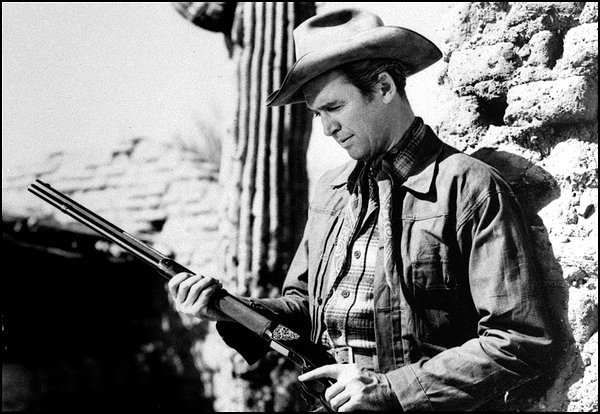
We had formed our own, most of us a year or so younger than the Bellboys, and called ourselves Winchesters ‘73 (I like to take credit for the name because even that early Western movies had already cast a mesmerizing spell over me) The Western movie of the same title starred James Stewart and was made in 1950, and probably got shown in our local theatres some years later.

Our original members were a closely-knit group mostly classmates in Ateneo. We had Arturo Anolin, Nazar Chaves, Eddie Acero, Boy Fernandez, Babe Fortich, Ernie De Leon, Boy Ramos, Baby Ramos, Roy Gaane, me, of course, Dixie Jongko, Jaime Waga, Jessnar Falcon, Rogelio "Butch" Bagabuyo, and Nonie Rivera, forming the core group that met regularly; though at some point or other, we also had others joining in like Iraido Aguilar, even Filamer Artajo and Gerry Agbulos, Tonito Rivera and a few more.

For some inexplicable reason that part of Divisoria, where the Bonifacio monument stands, has always been regarded as the official locale of the groups that would later on be collectively called The Plazans. I suspect that because even then trees there were already mature and tall enough to provide the needed shade near the benches, it became the place of choice. And ideal locale for shielding us from the unyielding sun during the daytime and the equally harsh tun-og during the night. Add the fact that for the Bellboys that was the most convenient locale for them to meet. For members like Tito Yee who resided along Pabayo Street; Tutti along JR Borja; Billy Alegarbes and Patuting along Filipinas St.; Bong Cabe from Cogon Subdivision usually brought along his jeep; Roque from across City Hall; Ed Chaves, as with a number of us, along Victoria St. or thereabouts.

Thus, so it was that the Bonifacio monument became identified with the Plazans, though there are four other subdivisions of Divisoria Plaza, from the amphitheatre near the river to the Masaysay monument dead-ended by the Xavier University grounds.

And many a day and night, we spent huddled together astride the dirty concrete benches, telling our stories, amusing and regaling ourselves with funny anecdotes, and trying to fight the night cold by sharing cigarettes 50-50. And in this regard, Tito Yee was specially regarded because he always smoked the more expensive Philip Morris, compared to the cheaper brands like Winfield, Fatima, Snowman, Newport, etc. that everybody else smoked. In fine, in a grand display of carefree adolescent chatter and time killing best describes how we spent whiling away our idle hours.

Then as I recall our days in the Plaza started getting rarer and less frequent when most of us approached the waning months of 4th year high school and that would be in 1958. At least for me personally, how it eventually ended was when high school came to an excruciating end.

In this regard then, I enjoin the others to continue on with their own stories as Plazans, with the earnest hope that a complete chronology can be established. And thus make more meaningful and coherent, the past and ensuing reunions that are being held. Especially because as you may have noticed even in the few names that I have detailed, a number have already passed on.

Lastly, I shall post this entry also in my own personal blog. Thus visitors can leave comments of correction, clarification, or addition.

                                                                   000000000000

UPDATE  July 5, 2020


We have a list of other gangs with their members, as reported by those eyewitnesses who were also members of gangs.

Blue Boyz – Rogie Lim, Tom Aguirre, Billy Walter, Benjie and Edgar Gorospe, Maning and Jesus Roska, Tony and Nandy Rodriguez, Dolfo Dolores, and an unlikely, Pacifico “Dodong” Pelaez.

James Dean Gang – Harry Willkom, Popoy Martinez, Lionel Mandig, Garby Aguirre, Francis Rebolos, Ricky Jonayon, Bobby Mutia, Manoling Jaldon.

Remingtons (short-lived) – Pondol and Ronnie Dadole, Benjie Gorospe.

Stalag (after the movie, Stalag 17, starring William Holden) - Danzig Sambaan, Loloy Gaabucayan, Paking Mercado, Carlos Yamut, Rudy Avancena, Ben Chaves, Nap Tayanes, Yoyong Gabutina, , Andoy Kong, Loloy and Leo Pabayo, Tony Orqueza, ( to be continued)

Lunars

Leathernecks (later in time) – members coming from other gangs.

HiFi Gang -  Jose “PePe” Balaba, Monix Lim, Felix Almerol, Buddy Blanco, Adrian and Leo Pabayo, Fidel and Le Grande Saa, Orlando V. Neri, Ramon V. Neri, Apolinar “Boy” Velez, Victor Guitarte, Loloy Pimentel, Manny Valdehuesa,
                                                                      
                                                                        0000000000000000

There was a younger group used to stnby at Dv Soria & along Filipinas st.,now T Chaves St. They were called THE PANTAK a fish family of HALUAN fish. 


They are The WILLKOM BROTHERS & cousins Joseph, George (Gemgem) Edgar Wilkom, Mike & Eddie Wilkom, Our mentors Russell & Gerald Willkom, Boy Laplap, Teddy Garcia, Tata Hernando, Bonbito Ruita, Ben Tan, Bebe Caharian, William Boy Willkom, Onching Roa, Sammy Ortes, Junsam Sambaan, Boy Pabillore & many, many more!


                                                                        00000000000000000000000000


UPDATE; March 12, 2023

Continuing the tracing of the history of the Plazans and the origin of the name itself, getting into the next decade after ours.  Plazan Francis Rebolos of New Mexico has now provided some account on the origin of the name.  Their gang (The Ruggeds) came in the decade of the 60's and Plazan Ricky Jonayon of Nazareth is now being attributed as the originator of the name Plazan(s).

Here is the account of Francis Rebolos in the vernacular addressing his comments to  viewers who asked:  

Ging, karon pa naku ni nabasa. Maayo sab nga nangutana ka ug ngano nga gitawag plazans. Its a long story pero to make it short nag sugod ni sa among grupo nga "Ruggeds" ang among stambayan ang Bonifacio,ang mga magulang namo dito sa Magasaysay, 

Adto nga time kaming mga Ruggeds dili na maayo ang dungog as labi nga si Ricky Jonayon pala away sige lang kita ug sumbagay, paregla ,out of control siya. Daghan na nanghawa kay lagi dautan na among dungog, mga babaye man labay sa divisoria singitan ug dili maayo, did-an na sa mga ginikanan mo tampo sa among grupo. 

So nag decide mi nga alisdan ang among ngalan from "Ruggeds" namili mi ug ngalan starting ni Magsaysay to Bonifacio, hangtud kang Rizal. pero walay napilian ni suggest si Ricky nga tungod kay diha man mi sa Bonifacio ga tambay dugangan nalang ug letter "N" bonifacian lugar pero joker man paminawon ingon si Ricky nga tungod kay diha man mi sa plaza ga estambay sumpayan na lang ug letter "N" ang word Plaza hence nahimong Plazan wala pai "s" sa nadugay tungod kay ang klase klaseng grupo diha man magkita nahimo na dayong "Plazans"....hence na Plazans na gyud.

Yes Toy , una inyong group if my memory would serve me right mga 1968 or 1970 tu . It was Ricky Jonayon that coined the name "Plazan"

                                                              ooooooooooooooooo

A number of us, including me, often wonder whatever happened to Rogie Lim, who was quite popular during our time as a pugilist.  I learned that he was the eldest son of Dulo Lim, who was for many years the manager of the local William Lines, located at the de Lara building in No. Divisoria.  His family lived on the upper floor of the same building.  Learned also that Rogie had lived quite an interesting life during his youth away from Cagayan de Oro.

Do we have any more stories about the Plazans we used to know?

                                                              oooooooooooooooo

Additional details from Bellboys member, Roque Gaerlan:

".. on the sides of the ruggeds i agree with francis that it ricky junayon who originated the name plazans. But on the side of the bellboys it bueno pimentel which bueno also establish the plazans official whistle. Every plazans is familiar with the tune up to the present time."

Yes, that unique and familiar call whistle very common with Plazans.  Have not heard that for a long time.


                                                                oooooooooooooooo

Monday, June 22, 2020

A TRUMP RALLY AFTER COVID19


                                   Link: https://youtu.be/E_wKLOq-30M

Now one can see why any exposure to the rally speeches of Trump, however fleeting, could risk some violent reaction, or even some dangers of exploding heads, emanating from those who loathe Trump.

HeHeHe.

He is such a quintessential showman, of no equal or comparable parallel in current history of US politics.  A very unorthodox campaigner, dispossessed of all the polite nuances of seasoned politicians of the past and maybe, the present. But then again Trump is so out of the mainstream, he has submerged himself so under the radar in what he does to promote himself and castigate his detractors.

His style definitely is one of a kind.  But is it all ideal, proper, and presidential?  The ensuring debate could result in very vigorous bones of contention that would see no end or resolution.  Just more irate detractors and acrimony against Trump.  Maybe even more noted converts from the fence to the side against Trump.  But Trump may believe that his committed base of support is among the countless and nameless multitude and forgotten masses of middle America, the thousands who attend his rallies and the millions who subscribe to his tweets.

So does Trump care much about all this?  The only thing certain is that he will continue his volleys of tweets and the theatrical tenor of his rally speeches.  Do they border on histrionics?   His detractors no doubt will readily nod in assent.  But I do believe that Trump is convinced that given the historic adversarial realities against him these are the ready options he can count on to try and level the playing field.

For this rally, I probably have gone through with about 20 minutes of playing time, but I promise to get to the whole thing, even if I have to scan view the whole piece.

Personally, I do not invest too much mind on the words of Trump.  Thus, in this regard I have rudimentary and shallow expectations from him. But his actions and their results I do monitory closely, and so far he has not disappointed me.  By most traditional standards he has exceeded the high expectations of many honest and unbiased observers. 

Thus, all things being equal, his actions ought to carry more weight in any decision-making the US electorate has to make in the coming election.  Thus, I feel the seeming absurdity of his detractors parsing his every statement looking for any “gotcha” angle.  They will and are uncovering many. But how much do they count, or do damage to a ship already full of holes, however unfairly inflicted, but still chugging along merrily?

Lastly, given the steely constitution and energetic passion that Trump has shown all this time, amidst “all the slings and arrows” thrown at him, I do believe he can weather through all this and mentally prepare himself for the ensuing bloody battle in his reelection bid.

The reelection could be as much a surprise as the first one.